

Dynamic vs Condenser Microphones: How to Actually Choose

About the author...
Dave has been taking gadgets apart since he was old enough to be told not to. Every pick here is checked against the manufacturer's own documentation rather than the retail listing, and each star rating starts from a product's real Amazon customer score before being adjusted for performance, build quality, features and value. Read more about how ratings are calculated.
Table of contents
-
Key Takeaways (TL;DR)
- Dynamic vs Condenser: The Decision That Actually Matters
- How a Moving Coil Makes a Dynamic Mic Both Rugged and Gain-Hungry
- Frequency Response: Why Dynamic Mics Really Do Roll Off the Highs and Lows
- Polar Patterns: Cardioid vs Supercardioid, and Why Rejection Matters
- The Real Cost of Going XLR: An Interface Is Part of the Purchase
-
FAQ
- Is a dynamic microphone better than a condenser for a home podcast or stream?
- Why do dynamic microphones need so much preamp gain?
- Will phantom power damage a dynamic microphone?
- What's the practical difference between cardioid and supercardioid?
- Do dynamic mics really have a worse frequency response than condensers?
- If I buy a USB dynamic mic, do I still need an audio interface?
- Choosing the Right Microphone for Your Room
A dynamic microphone is the right call for a loud, close-miked source in an untreated room: vocals, streaming, podcasting, drums, guitar amps. That's because its moving-coil design tolerates high sound pressure and naturally rejects background noise, while a condenser suits quiet, detailed sources in a treated space. The tradeoff is that a dynamic mic needs more preamp gain, and if it runs on XLR, it needs its own audio interface too.
That decision, dynamic or condenser, is the single most common point of confusion for anyone buying their first serious microphone. It gets framed as a budget question: dynamic is cheap, condenser is good, buy the condenser if you can stretch to it. That framing is wrong often enough to be worth correcting before you look at a single product. What actually separates the two is a physical mechanism inside each one, and that mechanism decides which microphone suits your room and your voice, not your budget tier. This guide covers that mechanism, what it does to sensitivity and frequency response, how polar patterns extend the same idea, and the extra purchase an XLR dynamic mic quietly requires.
Key Takeaways (TL;DR)
- Choose dynamic for loud, close sources in untreated rooms. Condensers suit quiet, detailed sources in a treated space.
- A moving coil, not a capacitor, generates the signal. That's what makes a dynamic mic rugged and fully passive.
- The same coil makes output low. Budget for roughly 55 to 60 dB of clean preamp gain.1
- Frequency response really is narrower. Most dynamic mics roll off well before 20 kHz.2
- Cardioid rejects sound from the rear; supercardioid rejects more from the sides, at the cost of a small rear lobe.2
- An XLR dynamic mic is only half a purchase. An audio interface with real gain is the other half.
- Phantom power will not damage a dynamic mic. It simply has nothing to power.3
Dynamic vs Condenser: The Decision That Actually Matters
The "podcaster mic" marketing push of the last decade has been mostly condensers, and it has quietly trained people to think condenser equals better. Meanwhile some of the most recognisable voices on radio and television are recorded on dynamic microphones, close-miked in rooms that are anything but acoustically treated. Neither camp is more legitimate than the other. They're built to do different jobs, and the job that matters is defined by your room and your source, not by which one gets marketed as the upgrade.
The variable that actually decides this is how much of your room a microphone will pick up along with your voice. An untreated bedroom or home office has a computer fan, a hard floor throwing back reflections, a housemate two rooms away, traffic outside. A condenser is built to be sensitive: that's the entire point of the design, and it will faithfully capture all of that alongside you. A dynamic mic is built to be comparatively deaf to everything that isn't right in front of it and close. Held a few inches from your mouth, it lets a surprising amount of a messy room simply disappear from the recording without you doing anything else.
Run that logic the other way and a condenser earns its keep. In a treated space, or recording something quiet and detailed such as a whispered vocal, an acoustic guitar, or a voiceover session where every breath and consonant matters, a condenser's greater sensitivity and extended top end capture texture a dynamic mic physically cannot. Price is a weak signal here. Entry-level examples of both exist at accessible price points, and premium versions of both exist at premium ones. The room and the source decide, not the shelf tag.
How a Moving Coil Makes a Dynamic Mic Both Rugged and Gain-Hungry
Inside a dynamic microphone, a lightweight diaphragm is physically attached to a small coil of wire. That coil sits inside a magnetic field made by a permanent magnet. Shure's own specification sheet for its SM7B, one of the best-known dynamic mics in use, lists the transducer type plainly as dynamic and describes a classic moving-coil design.4 Sound waves push the diaphragm back and forth. The coil moves with it through the magnetic field, and that movement generates a small electrical voltage directly, through basic electromagnetic induction. Nothing needs to be switched on. There's no battery, no external power, no active circuitry to fail.
That same coil-and-magnet assembly explains the ruggedness dynamic mics are known for. It's a simple, mechanically tough construction that shrugs off drops, humidity, and being handled roughly on a stage or a desk in a way a condenser's charged, tensioned diaphragm generally can't match. The catch is that the exact same mass makes the mic comparatively insensitive. It takes real sound pressure to move that heavier coil enough to generate a usable signal, so the voltage a dynamic mic hands off is genuinely tiny, typically measured in a fraction of a millivolt to a couple of millivolts.
A condenser works from the opposite starting point. Its diaphragm is a very light, tensioned membrane that forms one plate of a capacitor. That capacitor needs external power to charge it, delivered as phantom power over the same XLR cable, and it also runs a small internal preamp that boosts the signal before it leaves the microphone.3 That's why a condenser typically arrives at your interface already reasonably strong. A passive dynamic hands your interface a whisper it has to amplify almost from nothing. Shure's own guidance for the SM7B recommends a preamp with at least 60 dB of clean gain. It also notes plainly that many interfaces, mixers, and preamps only provide 40 to 50 dB.1 That gap, between what a dynamic mic needs and what an entry-level interface actually supplies, is the whole "gain-hungry" reputation this category has. It isn't specific to one expensive mic. It's the mechanism, and it applies to every passive dynamic microphone to some degree.
Frequency Response: Why Dynamic Mics Really Do Roll Off the Highs and Lows
Here's the fact worth getting right: dynamic microphones generally have a narrower frequency response than condensers, and they do tend to roll off some of the top end and low end rather than reproducing the full range of human hearing flat. That's the accurate version of the claim, and it's a direct mechanical consequence of the same moving mass that makes a dynamic mic rugged. Shure's specification for the SM58, arguably the most widely used dynamic vocal microphone in existence, quotes a range of 50 Hz to 15,000 Hz.2 Condenser microphones routinely quote a fuller 20 Hz to 20,000 Hz, closer to the outer limits of human hearing. A far lighter diaphragm can track both very fast and very slow air pressure changes, with less mechanical resistance getting in the way.
That narrower window is a feature for the jobs dynamic mics actually do, not a defect to apologize for. A vocalist singing inches from an SM58's grille, a snare drum, a guitar amp cranked to the point of distortion: these are loud, broadband, harsh sources, and a slightly tamed top end plus a controlled low end genuinely sounds better on them, not worse. It softens sibilance and cabinet buzz without any EQ work, and it's a large part of why the same handful of dynamic mic designs have stayed in continuous professional use for decades rather than being replaced by more "accurate" alternatives.
There are exceptions worth naming honestly. A handful of premium broadcast-style dynamics, the SM7B among them, are deliberately engineered for a wider, flatter response than a typical dynamic mic offers, closer to 20 Hz to 20,000 Hz on paper.4 That's a genuine outlier, achieved through careful mechanical design, not the norm for the category. Even those mics still don't resolve the finest detail, the sense of "air" around a voice, the way a good condenser does in a quiet, treated room. As a rule for shopping, expect a dynamic mic's spec sheet to show a shorter frequency range than a condenser's, and treat that as a description of what it's built for rather than a shortfall.
Polar Patterns: Cardioid vs Supercardioid, and Why Rejection Matters
A polar pattern describes which directions a microphone actually listens to, and it matters just as much as sensitivity when your room isn't treated. Cardioid is the pattern on the overwhelming majority of dynamic microphones: a heart-shaped zone of pickup that's most sensitive directly in front, noticeably reduced to the sides, and close to deaf at the rear. Shure's specification for the SM58 describes exactly that behaviour, noting that its uniform cardioid pattern isolates the main sound source and minimizes background noise, rejecting off-axis sound rather than picking it up indiscriminately.2
Supercardioid takes the same idea and narrows it further. The front pickup lobe is tighter than a cardioid's, and rejection from the sides is noticeably stronger. That's exactly why Shure describes its own supercardioid design as offering a tight polar pattern that excludes unwanted sound sources, calling it a good choice specifically for noisy or reverberant environments.2 The tradeoff is a small lobe of renewed sensitivity directly behind the mic, a quirk cardioid patterns mostly avoid. Position something noisy directly behind a supercardioid mic, a computer fan or a monitor speaker, and you'll hear more of it than you would with a cardioid in the same spot.
For most home setups, cardioid handles the job well on its own, provided you stay on-axis and reasonably close. Drift to the side or lean back and the tone visibly thins out, so consistent positioning matters more with a directional mic than people expect going in. Supercardioid earns its place in genuinely noisy or reflective rooms, multiple sound sources in the same space, a loud monitor nearby, a home with more foot traffic than a bedroom studio allows, as long as you also keep whatever's behind the mic quiet.
The Real Cost of Going XLR: An Interface Is Part of the Purchase
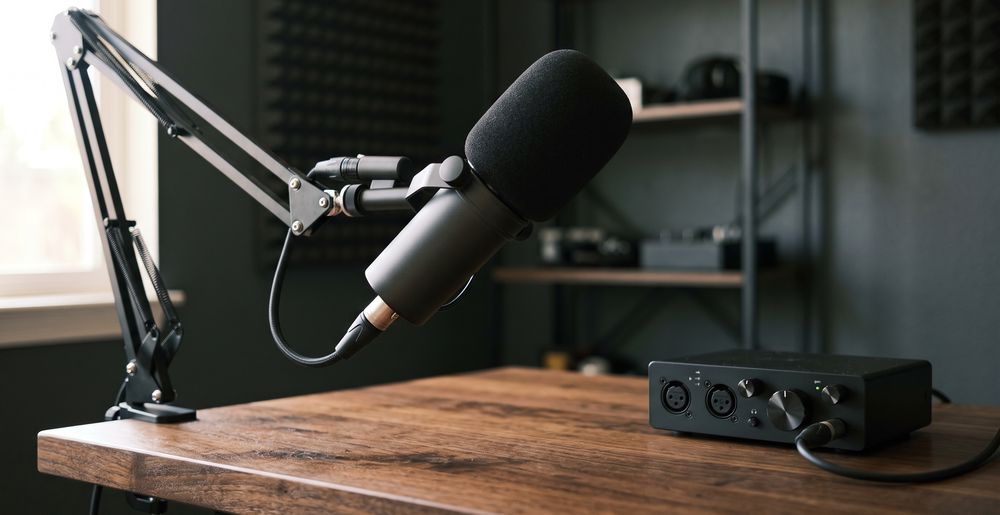
An XLR cable carries a balanced analogue audio signal and nothing else. It doesn't power anything, and it doesn't do any digital conversion on its own. That means an XLR microphone, dynamic or condenser, needs a separate device to amplify that signal to a usable level, convert it to digital, and hand it to a computer: an audio interface, a USB mixer, or a standalone recorder. If you're going condenser, that same device also has to supply phantom power. Buying the microphone is only the first half of the purchase.
This connects directly to the gain math already covered above. It's where a lot of first-time buyers get caught out. Pair a genuinely low-output XLR dynamic mic with a budget two-input interface offering only 40 to 45 dB of gain, and no amount of fiddling with the gain knob produces a clean recording. You either end up with a whisper-quiet track or a hiss-filled one pushed too hard trying to compensate. Treat the interface's published gain figure as part of the purchase decision at the same time as the microphone itself, not as an afterthought once the mic has already arrived.
USB and hybrid dynamic microphones sidestep the whole problem, which is why they dominate recommendations for a first setup. They contain a miniature interface and preamp inside the microphone body itself, so the low-output signal never has to travel down a cable to a separate box with variable, sometimes inadequate, gain on tap. The tradeoff is a bit less flexibility: a fixed onboard converter, and no XLR signal chain to build on if your setup grows later. For a first microphone with nothing else already bought, that tradeoff is usually the right one to accept.
Find a product: Best Dynamic MicrophonesFAQ
Is a dynamic microphone better than a condenser for a home podcast or stream?
Usually, yes, unless the room is genuinely treated. A dynamic mic's lower sensitivity and tighter polar pattern do a lot of the work that acoustic foam and reflection filters would otherwise have to do, which is why they're the default recommendation for a spare bedroom or a home office rather than a purpose-built studio.
Why do dynamic microphones need so much preamp gain?
Because they're passive: there's no active circuitry inside boosting the signal before it leaves the mic, only a moving coil generating a small voltage directly. Shure's guidance for the SM7B recommends a preamp with a minimum of 60 dB of gain, and notes that many mixers and interfaces only provide 40 to 50 dB, which is the specific gap that leaves buyers with a too-quiet recording.1
Will phantom power damage a dynamic microphone?
No. A dynamic mic has no active electronics to power, so phantom power sent to it simply isn't used. It doesn't need it and it isn't harmed by it, which is why leaving phantom power switched on when you plug in a dynamic mic alongside a condenser on the same mixer is standard practice.3
What's the practical difference between cardioid and supercardioid?
Cardioid picks up mostly what's in front, tapering off to the sides and largely ignoring the rear. Supercardioid narrows that front pickup further and rejects more from the sides, at the cost of a small lobe of renewed sensitivity directly behind the microphone.2 Cardioid suits most single-voice setups; supercardioid is worth it specifically in noisier or more reflective rooms.
Do dynamic mics really have a worse frequency response than condensers?
They have a narrower one, not simply a worse one. A widely used reference like the Shure SM58 is specified at 50 Hz to 15,000 Hz, short of the roughly 20 Hz to 20,000 Hz that condensers commonly quote.2 On loud, close-miked sources that narrower range tames harshness rather than losing anything a listener would actually miss.
If I buy a USB dynamic mic, do I still need an audio interface?
No, and that's the entire appeal. A USB or hybrid dynamic mic has its own preamp and analogue-to-digital converter built into the microphone body, so it plugs straight into a computer with nothing else to buy. An XLR-only dynamic mic doesn't have that built in, which is why it needs a separate interface.
Choosing the Right Microphone for Your Room
Start with the room, not the price. A dynamic microphone's moving-coil design is what makes it rugged, gain-hungry, and comparatively deaf to everything that isn't right in front of it, and all three of those traits come from the same piece of physics. That's exactly why it suits loud, close, untreated-room recording so well, and why its frequency response is genuinely narrower than a condenser's rather than simply worse. Add a cardioid or supercardioid pattern into the mix and you get a microphone built to ignore your surroundings almost as much as it captures your voice. The one thing worth budgeting for alongside it, if you're going XLR, is an interface with enough clean gain to actually use it. Once that's sorted, comparing specific models is the easy part.