

Light Bulb Security Cameras: Where They Actually Work

About the author...
Dave has been taking gadgets apart since he was old enough to be told not to. Every pick here is checked against the manufacturer's own documentation rather than the retail listing, and each star rating starts from a product's real Amazon customer score before being adjusted for performance, build quality, features and value. Read more about how ratings are calculated.
Table of contents
- Key Takeaways (TL;DR)
-
FAQ
- Will a light bulb security camera keep working during a power cut?
- How do I check whether my fitting is E27 or B22 before I buy?
- Can I install one in an exposed outdoor fixture, like a wall lantern in the rain?
- If the camera has two-way audio, are there separate rules for recording sound?
- Will a heavier camera overload an older light fixture?
- What happens to the camera if I move house or replace the light fitting?
- The Bottom Line
A light bulb security camera only works where the fixture can stay powered permanently, since any wall switch on that circuit has to stay on. The base must also match your fitting, either an E27 screw or a B22 bayonet cap, and unless the listing states an IP rating, treat the spot as covered use only.
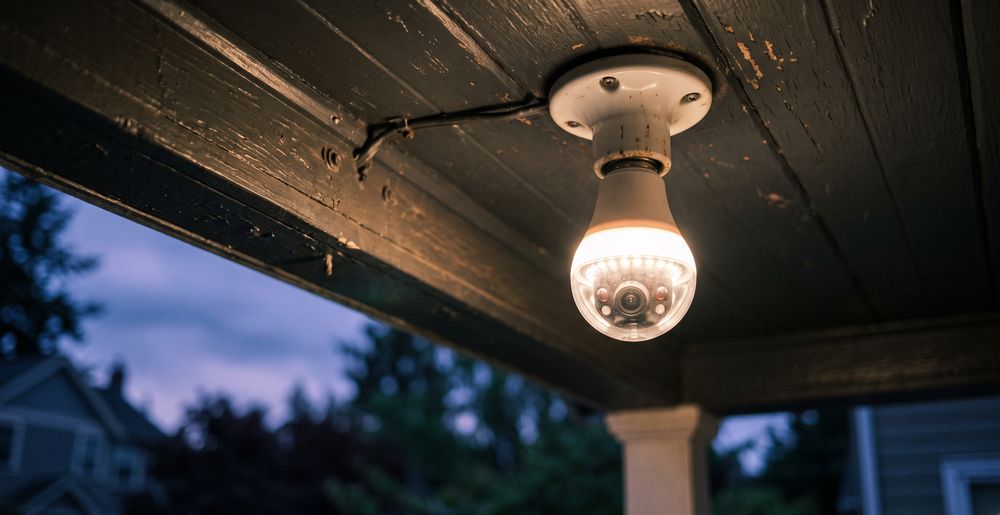
That's the whole category in one sentence. But each part of it decides whether the camera you buy actually functions where you plan to put it, rather than just looking right in a product photo. A bulb camera is a screw-in unit that takes the place of an ordinary lamp: no separate mount, no cable run, no drilling. It draws power straight from the light fitting the same way a bulb would. That's exactly why it suits a porch, a stairwell, a garage or a shed: somewhere there's a light already but no free plug socket nearby.
That convenience comes with real constraints most listings don't spell out. This guide covers the three things that actually decide whether one of these will work for you: keeping the fixture live, getting the cap type right, and being honest about what "outdoor" means on the box. It also covers when a bulb camera is the wrong tool entirely, and a plug-in or battery camera is the better call instead. For a side-by-side comparison of specific screw-in models on sensor resolution, storage and price, that's a separate piece of research. This guide links out to it.
Key Takeaways (TL;DR)
- The fixture must stay powered 24/7. Flip the wall switch off and the camera goes dark, not just the light.
- Power cuts blackout the camera completely, unlike a battery security camera that keeps running on its own charge.
- E27 and B22 caps aren't interchangeable. Check your actual fixture before ordering, not a generic product photo.
- Adapters add bulk. A screw-to-bayonet adapter stacks extra height behind an already large camera body.
- Few listings state an IP rating. Read "indoor and outdoor" as "under a roof" unless one is given.
- Moisture near a live mains connection is a safety issue, not only a picture-quality one.
- Disguise is the entire appeal of the format, traded against power reliability and sealing a dedicated camera handles better.
The Power Dependency: Why the Fixture Has to Stay Live
A bulb camera has no meaningful battery of its own. It runs off the same live connection a bulb would use, continuously, whether or not anyone in the house is thinking about the light at all. That's a different relationship with the wall switch than a normal bulb has. With a lamp, flicking the switch off at bedtime is simply what a light is for. With a bulb camera screwed into the same holder, the same action also switches off the camera, and that's the single most common installation mistake in this category. Someone fits the camera where the old bulb lived, then keeps using the switch exactly the way they always have.
The fix isn't complicated, but it does take a bit of planning before you install rather than after. Look for a fixture on a circuit that's genuinely never switched off in daily use. An outdoor light already running from a dusk-to-dawn sensor works well. So does a fitting with an isolator rather than a household light switch, or a spare socket nobody currently treats as a light switch at all. If the only available fixture does sit on a normal wall switch, there's a better fix than taping it down. A smart switch that keeps the load live and gives you app control instead of a mechanical toggle solves the problem properly. Taping a switch in place is a common workaround, but it also means every other person in the house has to know not to touch it. That's a weak point in itself.
The same dependency has a second consequence worth planning for. A genuine power cut takes the camera down completely, with no runtime to fall back on. A battery-powered security camera keeps recording off its own charge for hours or longer once the mains supply drops. A bulb camera has no equivalent reserve, because its entire design assumes the socket it's screwed into is always live. That's a reasonable trade for most households most of the time. But it's worth knowing before you rely on one as your only coverage for a location where losing power is a real possibility, not a rare inconvenience.
E27 or B22: Match Your Fitting Before You Buy
Two lamp cap families cover the vast majority of household fixtures. E27 is the larger threaded screw base, sometimes called an Edison screw. B22 is a bayonet cap that pushes in and twists a quarter turn to lock. A camera built for one will not physically fit a socket meant for the other, no amount of force changes that. Before ordering anything, take the current bulb out and look at its base rather than guessing from memory. Most homes mix both types across different rooms, bought over different years from different fixtures, so what's in the hallway isn't a reliable guide to what's in the porch light you actually want to cover.
Cheap adapters exist for converting one cap type to the other, and plenty of sellers include one or note compatibility on the listing. They solve the threading problem. They don't solve the space problem, though, and in some cases they make it worse. A bulb camera is already noticeably bulkier than the bulb it replaces. Stacking an adapter behind it adds further height and depth on top of that. A fixture with a tight shade or a recessed housing may already be a squeeze for the camera alone. It may simply not close around camera plus adapter. Measure the fixture's internal depth before you buy rather than after the box arrives.
Get the cap type wrong and there's no partial fix. It doesn't thread in loosely or sit slightly off. It doesn't fit at all, and returning it is the only option. Check the specific listing states the cap type rather than assuming a default, since sellers occasionally list the same camera body across both E27 and B22 versions and it's easy to land on the wrong one from a search result. Bayonet fittings remain common in some fixture ranges even where screw fittings dominate elsewhere, so don't assume your whole house uses one type just because most of it does.
Find a product: Best Light Bulb Security CamerasWeatherproofing: What "Indoor and Outdoor" Actually Means Here
Plenty of bulb camera listings say indoor and outdoor use in the same breath, without stating an ingress protection rating to back it up. IP ratings are defined by IEC 60529. That's the standard that sets the two-digit code covering how well an enclosure resists dust and water.1 A camera that actually states an IP figure has been tested against that standard. One that doesn't hasn't necessarily failed it. But there's no evidence it's passed either, and in this category, not stating a rating is closer to the norm than the exception. Read "outdoor" on a box without a rating attached as marketing language, not a certified claim.
There's a reason this matters more here than it does for a camera designed as a standalone outdoor unit from the start. The fixture a bulb camera screws into was originally engineered to hold a sealed glass bulb. It wasn't built for a circuit board carrying a lens, an antenna, a microphone and often a small LED array that runs warm. Consumer light fittings rated for outdoor bulbs aren't automatically sealed at the socket itself against wind-driven rain finding its way in around the cap. That's not only a risk to the footage. Moisture reaching a live mains connection is a safety issue in its own right, independent of whether the camera keeps working afterward.
The practical takeaway is simple: check the specific product's stated rating, not the category's general reputation, before fitting one anywhere genuinely exposed. A porch soffit, a covered walkway or a shed interior with the door usually shut are all reasonable spots for a camera without a published rating. A wall lantern taking driving rain straight on isn't, unless the listing explicitly backs that use with a real IP figure.
Bulb Camera vs a Dedicated Plug-In or Battery Camera
A bulb camera exists to solve one specific situation: there's already a light fitting where you want coverage, and no easy way to add a mount, run a cable, or reach a plug socket. That's the entire case for the format, and where that situation genuinely applies, nothing else installs as fast or blends in as well. It's worth being just as clear about what you give up to get that convenience, because the trade-off isn't small.
Power reliability is the first thing you give up. A bulb camera goes dark on any interruption to the circuit it's wired into, whether that's a flipped switch or a genuine outage. It has nothing of its own to fall back on. Weatherproofing is the second thing you give up. A dedicated outdoor security camera is designed as a sealed unit from the ground up, with its own IP rating built into the housing rather than retrofitted into a fixture that was never meant to hold one. A battery camera adds a third advantage on top of that: genuine outage independence. The cost is a unit you have to recharge periodically instead of one that just runs forever off the mains.
Choose a bulb camera when the fixture genuinely is your only practical option and the spot is under cover. Choose a dedicated plug-in or battery camera instead when either weatherproofing or staying recording through a power cut actually matters more than keeping the camera hidden in plain sight, which is often the case for a front-facing exterior wall or anywhere losing coverage during an outage would be a real problem rather than a minor gap.
FAQ
Will a light bulb security camera keep working during a power cut?
No. It draws power continuously from the fixture it's screwed into, and has no independent battery to fall back on. A mains outage takes it offline the same as it would any other light in the house. A battery-powered security camera is built specifically to keep recording through an outage off its own charge. If losing coverage during a power cut is a real concern for a particular location, that's a point in favour of a battery unit for that spot specifically.
How do I check whether my fitting is E27 or B22 before I buy?
Remove the current bulb and look at its base rather than relying on memory or assuming your whole house uses one type. E27 is the larger threaded screw cap. B22 is the bayonet type that pushes in and twists a short turn to lock. The two aren't interchangeable without an adapter, and getting it wrong means the camera simply won't fit, with no partial workaround available.
Can I install one in an exposed outdoor fixture, like a wall lantern in the rain?
Only if the specific product states an IP rating that covers that level of exposure. IP ratings are defined by IEC 60529 and describe how well an enclosure has actually been tested against dust and water ingress.1 Most bulb cameras don't publish one at all, despite "outdoor" appearing on the packaging. Treat an unrated camera as suitable for covered spots only: a porch soffit or a shed interior, not a fitting taking rain directly.
If the camera has two-way audio, are there separate rules for recording sound?
Often, yes. It's worth treating as its own check rather than assuming the same rules that cover video also cover audio. Regulatory guidance on video surveillance devices flags the addition of audio recording as something that needs its own specific policy and justification, on top of whatever already covers the video itself.2 Exactly what's required, and how strictly it's enforced, varies a great deal from place to place. If your camera has always-on or two-way audio, check the rules that apply where you live. Don't assume the video-only guidance covers it too.
Will a heavier camera overload an older light fixture?
It's worth checking rather than assuming it's fine, particularly on an older fitting. A bulb camera weighs more and draws more continuous current than the LED or incandescent bulb it's replacing, and an aging lamp holder wasn't necessarily specified with that in mind. Check the camera's stated weight and power draw against what your fixture and its wiring are rated to handle, and if the fitting is old, worn, or you're not confident reading its rating yourself, that's a reasonable point to get an electrician to check it rather than guess.
What happens to the camera if I move house or replace the light fitting?
It comes out with you, the same as any bulb would, since it's just screwed into the holder rather than fixed to the wall or ceiling itself. The one thing to plan for is putting an ordinary bulb back in before you leave, since a landlord or new occupant won't necessarily know what they're looking at, and a camera left running in a home you no longer live in raises exactly the privacy questions you'd expect. Keep the original bulb somewhere you'll actually find it again.
The Bottom Line
Get the fundamentals right and a bulb camera does exactly what it promises: a working camera in a spot where there's a light fitting and nothing else practical to mount to. Keep the fixture on a circuit that's genuinely always live, since a wall switch flicked off the normal way takes the camera down with the light. Check your actual fitting's cap type before ordering rather than assuming, since E27 and B22 aren't interchangeable and adapters add bulk on top of a camera that's already larger than the bulb it replaces. Treat an unrated product as covered-use only, because most of this category never states an IP figure at all despite outdoor claims on the box, and water reaching a live connection is a safety issue as much as a picture one. And weigh the trade honestly: the whole appeal of this format is disguise and convenience through a fixture you already have, set against the power reliability and weatherproofing a dedicated plug-in or battery camera handles better by design.