

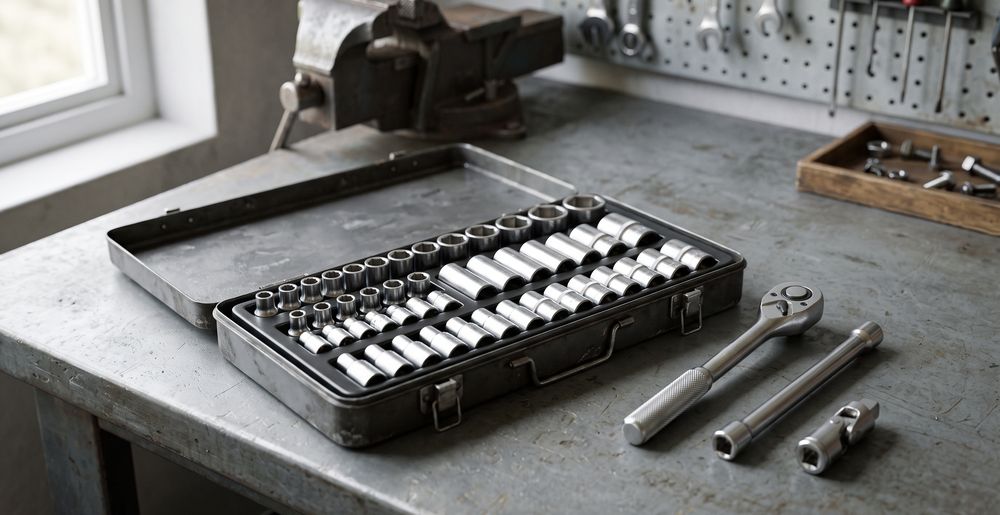
3/8 Inch Drive Sockets: How to Choose the Right Set

About the author...
Dave has been taking gadgets apart since he was old enough to be told not to. Every pick here is checked against the manufacturer's own documentation rather than the retail listing, and each star rating starts from a product's real Amazon customer score before being adjusted for performance, build quality, features and value. Read more about how ratings are calculated.
Table of contents
- Key Takeaways (TL;DR)
-
FAQ
- Is a 3/8-inch drive set strong enough to change a wheel?
- Why do some socket sets list way more pieces than they have sockets?
- Do twelve-point sockets round off bolts more than six-point ones?
- What's actually different between Cr-V and Cr-Mo sockets?
- Is a clicking ratchet the same thing as a torque wrench?
- How often does a torque wrench need recalibrating?
- The Bottom Line
A 3/8-inch drive socket set is the right general-purpose choice for most repair and DIY work. It's the middle ground between 1/4-inch (small, delicate fasteners) and 1/2-inch (high-torque jobs). It is not the right tool for a car's wheel nuts, though. That job calls for a 1/2-inch drive torque wrench, because manufacturer torque specs for wheel nuts commonly sit above what a 3/8-inch tool is built to handle reliably.12
That correction matters because it is a genuinely common mix-up. A socket set gets bought for "the car and the house," and the drive size printed on the box rarely explains what it's actually for. This guide covers the decisions that come before comparing specific sets: what drive size means mechanically, when six-point beats twelve-point, why a "45-piece" set can hold as few as nine sockets, what Cr-V and Cr-Mo steel actually buy you, and why a ratchet and a torque wrench are not interchangeable tools even though they look similar in your hand.
Key Takeaways (TL;DR)
- 3/8-inch drive is the practical middle ground between 1/4-inch (delicate work) and 1/2-inch (high-torque jobs).
- Wheel nuts need a 1/2-inch drive torque wrench, not a 3/8 set. Manufacturer torque figures routinely exceed what 3/8-inch tools are rated for.
- Six-point sockets grip the flats of a fastener and resist rounding. Twelve-point sockets fit awkward angles but round softer fasteners more easily.
- "Piece count" is routinely inflated by counting the case, extension bars, adapters and screwdriver bits as if they were sockets.
- Cr-V suits hand-tool sockets; Cr-Mo suits impact use, though plenty of "impact" sets quietly use Cr-V with a black finish instead.
- A ratchet has no idea how tight is tight. Only a torque wrench measures and limits the force you're applying.
- Torque specs are set per vehicle, not per drive size, so always check the actual figure for the fastener you're working on.
Drive Size — What 1/4, 3/8 and 1/2 Inch Actually Mean
The drive size on a socket set refers to the square tang on the ratchet and the matching square hole in the back of each socket. It has nothing to do with the size of any fastener it turns. The three sizes you'll meet in general use are 1/4, 3/8 and 1/2 inch, and each is a trade name rather than an exact fractional measurement.1 A bigger square simply transmits more torque before it twists or rounds off. That's the whole reason the sizes exist as a ladder rather than one universal fitting.
Quarter-inch drive is built for small, low-torque fasteners: electronics, interior trim, small appliances, anything where a heavier tool would be clumsy or risk snapping something delicate. Half-inch drive sits at the other end, built for sustained high-torque work: suspension components, structural bolts, and wheel nuts. Three-eighths drive is the compromise in the middle, strong enough for the great majority of automotive and household fastener work without the bulk of a half-inch set.
This is exactly where the old advice about 3/8 sets and tyre changes goes wrong. Wheel nut torque is specified per vehicle by the manufacturer. Individual owner's manuals commonly specify anywhere from around 60 to over 100 lb-ft depending on the car, and typical passenger-car charts summarise the range as roughly 80 to 100 lb-ft, with trucks and larger SUVs often higher still.2 A 1/2-inch drive tool is the standard choice for this job. It's built for that torque range and for the repeated, high-load cycling a wheel change puts it through. Adaptors exist to step a 3/8 ratchet up to 1/2-inch sockets, but they add a weak point. That's not a good plan for something safety-critical like wheel nuts.
Six-Point vs Twelve-Point Sockets — When Each One Wins
Look inside a socket and you'll find either six flat faces or twelve. Six-point sockets are shaped to match a standard hex fastener exactly, contacting the full flat of each face rather than the corner. That spreads the load evenly and is why six-point is the safer default when a fastener is rounded, rusted, or seized: there's simply more contact area resisting the slip that rounds a bolt head.
Twelve-point sockets fit onto the same hex fastener at twice as many positions, engaging every 30 degrees instead of every 60.1 That matters in tight spaces where you can't swing a ratchet far enough to reseat a six-point socket, or where a wrench needs to go on and off repeatedly at odd angles. The trade-off is that a twelve-point socket bears more on the corners of the fastener than the flats, which is exactly what makes it round off a soft or already-worn bolt head faster.
Neither profile is objectively better. Six-point is the right default for anything you expect to be tight, old, or worth protecting. Twelve-point earns its place when clearance is the actual problem, not the fastener's condition.
Real Piece Counts vs Marketing Piece Counts
The single most misleading number in this category is the headline piece count on the box. Manufacturers routinely count the carry case, extension bars, universal joints, drive adaptors and screwdriver bits as "pieces" alongside the actual sockets. So a "45-piece" set and a "29-piece" set can hold a similar number of usable sockets, or wildly different ones. Our own comparison of 3/8 drive socket sets found sets where fewer than a third of the advertised pieces were sockets at all, with the rest made up of bits, bars and the box itself.
The fix is simple: ignore the piece count on the packaging and check the actual socket range instead. A listing that breaks down shallow, deep and spark plug sockets separately, with specific sizes, is telling you what you're really getting. A listing that only quotes a big round number is hoping you won't ask.
Find a product: Best 3/8 Socket SetsCr-V vs Cr-Mo Steel — What the Label Is Actually Telling You
Chrome vanadium (Cr-V) is the standard alloy for hand-tool sockets. It hardens well and holds an edge, which is what a socket needs when it's being turned by hand or with a ratchet under steady, controlled force. Chrome molybdenum (Cr-Mo) is the alloy more commonly specified for impact sockets, because it's tougher and better suited to absorbing the sudden, repeated shock loading an impact wrench or gun delivers, rather than the smooth pull of a hand tool.
The catch is that plenty of sockets sold as "impact sets" actually use Cr-V steel with a black phosphate finish, which looks the part but isn't the same specification as genuine Cr-Mo. That isn't automatically a problem: a Cr-V socket with an impact-style finish will often tolerate light impact use just fine. It's worth knowing the difference exists, though, before assuming every black socket in a set is built to the same standard as one stamped Cr-Mo.
Torque Wrench vs Ratchet — Two Different Jobs
A ratchet is a direction-selecting handle. It lets you apply force to a fastener and keeps that force going one way while you reset your grip, and that's the entire job it does. It has no way of knowing, or telling you, how much force you've actually applied. Tighten with a ratchet alone and you're going by feel, which is fine for a shelf bracket and genuinely risky for anything with a specified torque figure.
A torque wrench solves that by measuring the force you're applying and stopping or signalling once you hit a preset value. Click-type torque wrenches use a spring-loaded mechanism that releases with an audible click at the set torque, while simpler beam-type wrenches show the applied torque on a scale as you pull.3 Both do the same underlying job differently: turning "tighten it firmly" into a specific, repeatable number.
This is exactly the distinction that matters for wheel nuts, cylinder heads, suspension components and anything else with a torque spec in the manual. Manufacturer figures vary by vehicle, wheel design and stud size. There's no universal number to memorise. What stays constant is the method. Final tightening on anything torque-critical should be done with a calibrated torque wrench, not just a ratchet or an impact tool run by feel.2 Torque wrenches also need periodic recalibration to stay accurate, typically after several thousand cycles of use or roughly a year, whichever comes first.3 A wrench that's been dropped, over-torqued, or simply used hard for years can drift without any obvious sign.
FAQ
Is a 3/8-inch drive set strong enough to change a wheel?
For breaking loose and running down the nuts, often yes, but final tightening to spec is a different matter. Typical passenger-car figures run roughly 80 to 100 lb-ft, individual manuals range from around 60 to over 100 lb-ft, and trucks and larger SUVs can specify considerably more.2 A 1/2-inch drive torque wrench is the standard tool for that job because it's built for that torque range and the repeated high load of a wheel change. Use the exact figure in your vehicle's handbook, not a generic number, since it varies by manufacturer and wheel design.
Why do some socket sets list way more pieces than they have sockets?
Because the headline number usually counts everything in the case, not just sockets. Extension bars, universal joints, drive adaptors and screwdriver bits all get added to the total, so a big piece count can describe a set with a fairly small number of actual sockets. Checking the specific socket sizes and depths listed, rather than the total piece count, is the only reliable way to know what you're buying.
Do twelve-point sockets round off bolts more than six-point ones?
Generally, yes, on fasteners that are already worn, soft or corroded. A twelve-point socket contacts a hex fastener closer to its corners, engaging every 30 degrees rather than every 60.1 That's useful when there's no room to swing a six-point socket back onto the fastener, but it gives up some of the flat-face grip that makes six-point sockets more resistant to rounding.
What's actually different between Cr-V and Cr-Mo sockets?
Chrome vanadium is the usual choice for hand-tool sockets, hard enough to hold up under steady, controlled turning force. Chrome molybdenum is tougher and better suited to the sudden shock loading an impact wrench delivers, which is why genuine impact sockets are more often specified in it. Some sockets marketed as "impact" sets are actually Cr-V with an impact-style black finish rather than true Cr-Mo, so the label alone doesn't guarantee the specification.
Is a clicking ratchet the same thing as a torque wrench?
No. A ratchet only controls which direction force is applied; it has no mechanism for measuring or limiting that force. A torque wrench measures the applied torque and stops or signals at a preset value, commonly with an audible click in click-type designs.3 Anything with a specified torque figure, wheel nuts included, should be finished with a torque wrench rather than a plain ratchet.
How often does a torque wrench need recalibrating?
As a general guide, roughly every 5,000 uses or about once a year, whichever comes first, and sooner if it's been dropped or used at or beyond its rated maximum.3 A torque wrench that's drifted out of calibration won't look or feel any different in use, which is exactly why it's worth checking rather than assuming.
The Bottom Line
Three-eighths drive earns its place as the set most people should own first, because it covers the widest band of everyday fastener work without the bulk of a half-inch set. What it isn't is a universal tool: wheel nuts belong to 1/2-inch drive and a proper torque wrench, not a ratchet run by feel. Beyond drive size, the decisions that actually separate a good set from a disappointing one are the real socket count behind the piece-count number, six-point versus twelve-point for the fasteners you actually work on, and whether the steel matches the job you'll put it through. Get those right first, and comparing specific sets becomes a much shorter job.