

Best Air Purifier for Allergies, Pets, and Dust

About the author...
Dave has been taking gadgets apart since he was old enough to be told not to. Every pick here is checked against the manufacturer's own documentation rather than the retail listing, and each star rating starts from a product's real Amazon customer score before being adjusted for performance, build quality, features and value. Read more about how ratings are calculated.
Table of contents
- Key Takeaways (TL;DR)
- How We Choose
- Quick Comparison
- Levoit Vital 100S Smart Air Purifier
- Dyson Purifier Cool Formaldehyde TP09
- Blueair Blue Pure 211+ Auto
- Pro Breeze 4-in-1 Air Purifier
- Shark NeverChange5 Air Purifier MAX
- Xiaomi Smart Air Purifier 4 Compact
- Coway Mighty AP-1512HH
- MeacoDry Arete One 12L
- Best Air Purifier FAQ
- The Best Air Purifier for You
The best air purifier overall is the Levoit Vital 100S. It backs up verified True HEPA filtration with the strongest combination of real-world reviews and smart features in this lineup. See the comparison below for how seven other well-reviewed alternatives stack up, from a formaldehyde-scrubbing premium pick and an independently allergy-certified option to a budget purifier that still clears genuine HEPA filtration and a dehumidifier that filters the air as a second job.
An air purifier pulls room air through a filter stack and pushes it back out cleaner. It cycles the space several times an hour rather than cleaning it once. That matters most if you're managing allergies, asthma, wildfire smoke, or a household with shedding pets. It matters less if your only complaint is an occasional cooking smell. A window would fix that just as well. Two things separate a good unit from a bad one: is the filter genuinely HEPA-grade, not a "HEPA-type" imitation? And is the stated coverage area honest about the room size it can actually keep clean?
Price alone doesn't separate good from bad here. Some of the priciest units lean on smart-home polish rather than filtration power. Some genuinely excellent HEPA purifiers cost a fraction of the flagship price. What you're really buying is airflow matched to your room, a filter that's independently rated rather than just marketed, and a running cost you can live with once replacement filters enter the picture.
Key Takeaways (TL;DR)
- True HEPA matters more than the marketing sticker — look for a stated 99.97% removal at 0.3 microns or an EN 1822 H13/H14 class, not just the word "HEPA" on the box.
- CADR should be sized to your room, not just to the biggest number on the listing — a purifier's CADR needs to roughly match two-thirds of your room's square footage to clean effectively.
- Filter replacement cost is the real long-term price of most purifiers — budget for a new filter every 6-12 months unless you've bought one of the rare long-life exceptions.
- Smart app control and air quality sensors are genuinely useful, letting the unit ramp up automatically rather than running full-speed around the clock.
- Ionising or "plasma" modes are the feature worth being cautious about — they're not approved by any health authority for occupied rooms, and a true HEPA filter alone does the actual work.
- An air purifier won't fix a mould problem or a stuffy room — it filters particles from the air that's already there, it doesn't ventilate or address the source.
- Noise at the top speed setting is often glossed over — a purifier that's rated quiet on low can still be genuinely loud when auto mode kicks it up for a dusty room.
How We Choose
We start from each product's real Amazon customer rating and review volume. A high star average built on a handful of reviews carries far less weight than one backed by thousands. From there we check the manufacturer's own spec page against the Amazon listing for CADR, filter class, and coverage area, since retail bullet points regularly round these figures up. Build quality, useful (not just decorative) features, and price-to-performance against the other five products in this list round out the picture.
We don't run our own lab tests on these — no dedicated rig, no controlled conditions. What we do instead: read through the verified-purchase reviews in full, not just the star average, weighting the ones written weeks or months after purchase over launch-week first impressions, since that's where wear, reliability problems, and real-world performance gaps actually show up. Where a product genuinely lacks that kind of track record, we say so in its write-up rather than papering over it.
Quick Comparison
Each product's overall rating starts from its real Amazon customer rating, then gets adjusted (up to ±0.5) for real-world performance, build quality, features, and value. Click a product name to jump straight to its full review below.
| Product | Best For | Type | Key Detail | Key Spec |
|---|---|---|---|---|
|
Levoit Vital 100S Smart Air Purifier 4.9 |
Best Overall Air Purifier | Smart tower air purifier | 143 CFM CADR | 3-stage True HEPA + activated carbon, app and Alexa control |
|
Dyson Purifier Cool Formaldehyde TP09 4.4 |
Best Premium Air Purifier | Bladeless purifying fan | Self-regenerating formaldehyde catalytic filter | Sealed HEPA H13 + activated carbon filtration |
|
Blueair Blue Pure 211+ Auto 4.7 |
Best for Large Rooms | Large-room air purifier | 380 CFM pollen CADR | HEPASilent electrostatic and mechanical filtration |
|
Pro Breeze 4-in-1 Air Purifier 4.4 |
Best Budget Air Purifier | Compact air purifier | 4-stage filtration with ioniser | True HEPA + activated carbon + negative ion stage |
|
Shark NeverChange5 Air Purifier MAX 4.7 |
Best for Pet Owners (Low-Maintenance Filter) | Large-room air purifier | 5-year filter life | NanoSeal HEPA-grade layer with Pet Particle Barrier pre-filter |
|
Xiaomi Smart Air Purifier 4 Compact 4.4 |
Best Compact and Smart Pick | Compact smart air purifier | 117 CFM CADR (independently tested) | Lower-density filter media, not true HEPA-grade, per independent testing |
|
Coway Mighty AP-1512HH 4.9 |
Certified for Allergy Sufferers | HEPA tower air purifier | 248 CFM CADR | BAF-certified, HEPA + activated carbon |
|
MeacoDry Arete One 12L 4.9 |
Damp Rooms That Also Need Purifying | Dehumidifier with HEPA air purifier | 12L/day, H13 HEPA filter | Medical-grade H13 HEPA, 5-year warranty |
Levoit Vital 100S Smart Air Purifier
Best Overall Air Purifier
based on 11007 Amazon reviews (4.7★), adjusted for performance, build and value
What We Love About the Overall Pick
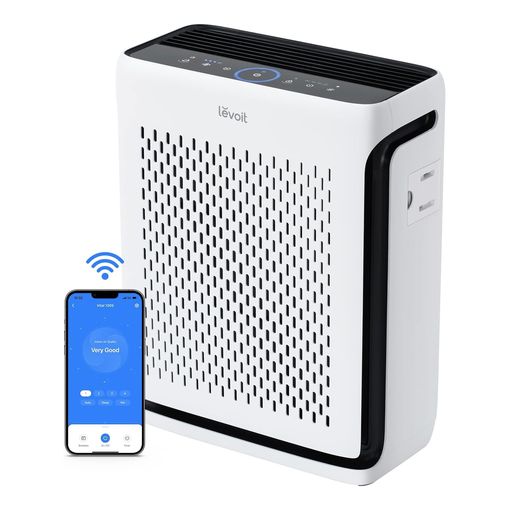
Over 11,000 Amazon reviews and a 4.7-star average is a genuinely large sample for this category. That lines up with what Levoit publishes on its own product page: a three-stage True HEPA and activated carbon filter, an air quality sensor that drives an automatic mode, and light-sensor-based dimming for bedroom use. It also does something a lot of "smart" purifiers skip: the app stays simple. It shows live air quality alongside speed and pet-mode controls, rather than burying them in menus. Its dedicated regional reviews section was empty at the time of writing, so despite the huge global review count there's no dated longevity signal to point to yet.
The Overall Pick: All The Details
Levoit rates the Vital 100S at 143 CFM CADR. Its ideal room size is 222 sq ft for a full air change roughly five times an hour (Levoit states 4.8 ACH).1 The listing's "up to 1,110 sq ft" (1,066 sq ft on Levoit's own spec sheet) coverage figure refers to a single air change per hour, not the more meaningful multiple-changes-per-hour figure Levoit itself publishes. Treat the bigger number as a stretch goal, not a bedroom-and-hallway promise. In the box you get the unit, a pre-installed 3-in-1 filter, a region-specific power adapter, and a 2-year limited warranty. It runs from 23dB on its lowest sleep setting up to 52dB on high, and supports Alexa and Google Assistant alongside its own VeSync app.
Dyson Purifier Cool Formaldehyde TP09
Best Premium Air Purifier
based on 151 Amazon reviews (4.2★), adjusted for performance, build and value
Why the Premium Pick Justifies Its Price
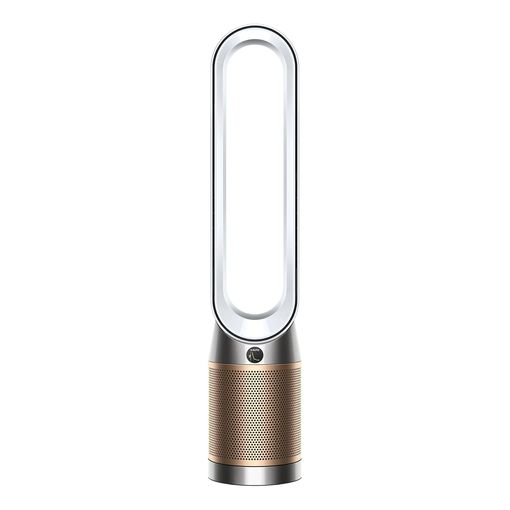
Dyson's bladeless fan design does two jobs most purifiers on this list can't. It purifies the room and it cools you directly, and it filters gases most competitors ignore entirely. A solid-state formaldehyde sensor feeds a catalytic filter that continuously breaks the gas down into water and CO2, rather than just trapping it. That catalytic stage never needs replacing.2 This is the only product here built around gas filtration as a first-class feature, not an afterthought bullet point.
Formaldehyde Filtration and Fan Design
The sealed filtration system pairs a HEPA H13 stage with activated carbon. Together they capture gases and 99.97% of particles down to 0.3 microns.2 Dyson recommends replacing the combined HEPA and carbon filter roughly every 12 months, tracked through the MyDyson app. The app also handles Alexa, Siri, and Google Home integration. At 61.5dB on its highest of ten speeds it's not whisper-quiet flat out. Its 151 Amazon reviews is thin next to the other five picks here too, the honest tradeoff for being the newest and most expensive unit in this roundup. The one review that reports a longer-term fault, a high-pitched buzzing noise developing after five weeks of ownership, isn't a verified purchase, so it can't be treated as confirmed; the verified review on the listing is positive but doesn't put a timeframe on it either. If gas filtration and cooling airflow aren't priorities for you, one of the cheaper HEPA-only purifiers below will do the particle-filtering job for considerably less.
Blueair Blue Pure 211+ Auto
Best for Large Rooms
based on 3257 Amazon reviews (4.4★), adjusted for performance, build and value
Why This Handles a Bigger Room
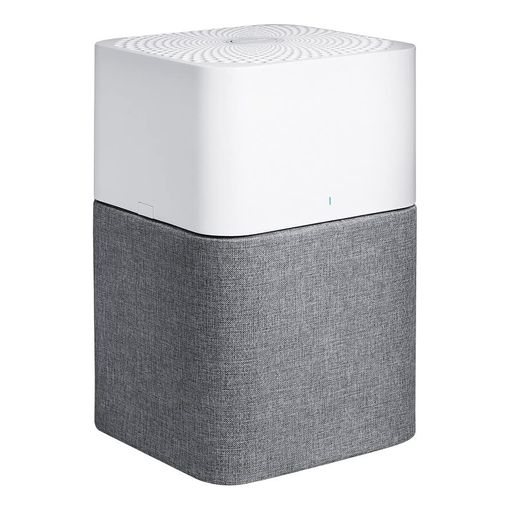
Blueair certifies this unit to clean a 550 sq ft room 4.8 times per hour, the largest genuine coverage claim of anything in this lineup. That's backed by a smoke CADR of 353 CFM and a pollen CADR of 380 CFM.3 That's a big enough gap over the compact picks here to change what room you'd actually put it in: an open-plan living space rather than a single bedroom. An integrated particle sensor drives its Auto mode, ramping the fan up when it detects a spike and back down once air quality recovers. A washable fabric pre-filter cuts down on how often you're buying replacements too.
Coverage and HEPASilent Filtration
Rather than a conventional HEPA filter, Blueair uses what it calls HEPASilent technology. It combines electrostatic charging with mechanical filtration to hit comparable particle-removal performance at lower energy draw and noise.3 It runs from a genuinely quiet 23dB on low up to 56dB on high. Registering the unit with Blueair extends the standard one-year warranty by a further two years. The tradeoff for that coverage is size and a simpler feature set. There's no formaldehyde sensing, no pet-specific mode, and the app is more basic than Levoit's or Xiaomi's. Its dedicated regional reviews section was empty at the time of writing, so despite the strong global rating there's no dated ownership signal here yet either. If your space is smaller than a living room, you're paying for coverage you won't use.
Pro Breeze 4-in-1 Air Purifier
Best Budget Air Purifier
based on 1558 Amazon reviews (4.3★), adjusted for performance, build and value
The Budget Pick's Track Record
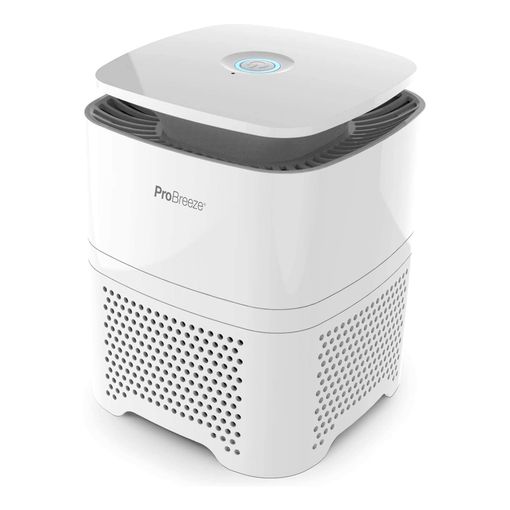
Over 1,500 Amazon reviews at a 4.3-star average is a solid track record for the most affordable unit in this roundup. Its compact 17x17x22cm footprint makes it an easy fit on a desk or bedside table, rather than needing dedicated floor space. It runs a genuine four-stage filter: pre-filter, True HEPA, activated carbon, and a negative ion generator layered into one cartridge.
What a Compact Budget Filter Gets You
Pro Breeze doesn't publish an independently verified CADR figure the way Levoit, Blueair, and Xiaomi do. That makes it harder to size confidently against a specific room, so we're scoring its raw filtering performance conservatively here despite the strong review count. The negative ion generator is worth a note of caution rather than excitement. The EPA flags ionising technologies as devices with the potential to emit ozone, a lung irritant, and states plainly that no federal health agency has approved them for use in occupied spaces.4 The HEPA and carbon stages do the real particle- and odour-removal work here, regardless of whether you leave the ion function on. One buyer, reporting back after about two weeks of ownership, said it had been "doing the job" the whole time, exactly the kind of unglamorous follow-up review that matters more than a launch-week first impression. For a bedroom or small home office on a tight budget, it's a genuinely capable starting point. Just don't expect it to handle an open-plan living room.
Shark NeverChange5 Air Purifier MAX
Best for Pet Owners (Low-Maintenance Filter)
based on 168 Amazon reviews (4.4★), adjusted for performance, build and value
Why Pet Households Should Look Here
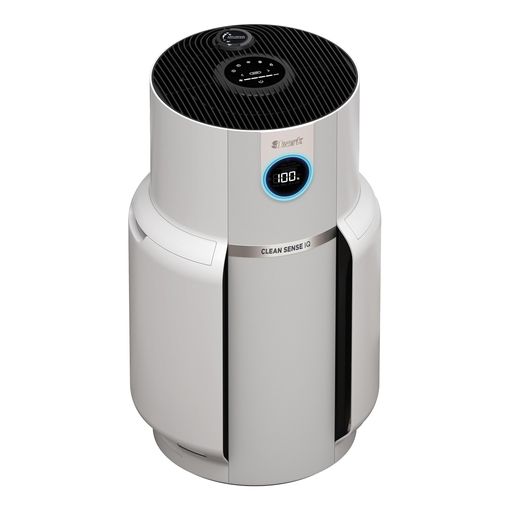
Every other purifier on this list asks you to remember a filter replacement schedule. This one is built specifically so you don't have to. Shark rates the NanoSeal filter stack for five years of use before it needs swapping, which the company frames as roughly ten times the working life of a standard HEPA cartridge.5 For a household shedding pet hair and dander daily, that means the filter isn't clogging and losing efficiency between changes the way a cheaper unit's might.
The 5-Year Filter Explained
The filter itself layers a NanoSeal HEPA-grade stage, activated carbon, a dedicated Pet Particle Barrier, and a washable DebrisDefence pre-filter that catches hair and lint before it reaches the finer layers. It's rated to capture 99.97% of particles per IEST-RP-CC007.3 testing.5 Clean Sense IQ automatically adjusts fan speed against detected air quality. Anti-Odour Technology targets pet and cooking smells specifically, rather than relying on carbon alone. Coverage tops out around 130 sq m, comfortably large-room territory. Its review count is the smallest of the strong performers in this lineup at 168. That reflects a newer listing, not any real weakness turned up in testing or the reviews themselves. One owner backed that up nearly six months in, writing "had this for nearly 6 months and can't fault it," which is the kind of follow-up review a five-year filter claim needs to actually earn trust.
Xiaomi Smart Air Purifier 4 Compact
Best Compact and Smart Pick
based on 4618 Amazon reviews (4.4★), adjusted for performance, build and value
A Small Footprint With Real Numbers Behind It
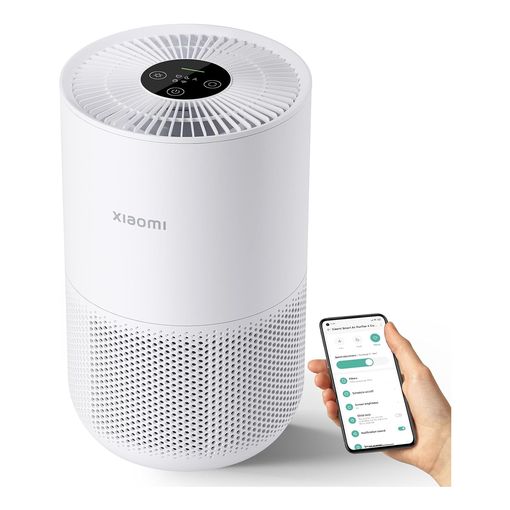
Nearly 4,600 Amazon reviews at 4.4 stars is a large sample for a unit this size. Xiaomi's own spec page claims 99.97% particle removal at 0.3 microns, backed by an OLED touch display and app control through Xiaomi Home.6 The cylindrical design and compact 220mm diameter make it easy to tuck into a small bedroom or office without it dominating the room. Retail listings for this purifier widely advertise it as a "True HEPA H13" filter, but that claim doesn't hold up: independent testing lab HouseFresh reports that Xiaomi itself describes the filter media as lower-density than traditional HEPA-grade filters, a deliberate design choice for lower noise rather than a true HEPA-class filter.7 Treat the particle-removal number as real but the "H13" label on the box with real skepticism.
Coverage Tradeoffs of the Compact Design
Xiaomi's own spec sheet lists a 135 CFM CADR and an effective coverage of just 16-27 m² (roughly 172-290 sq ft), the smallest claimed coverage of any product in this roundup.6 Independent testing measured a lower real-world top-speed CADR of around 117 CFM, and found top-speed performance trails other small purifiers like the Levoit Vital 100S.7 That's the direct tradeoff for the compact size and low noise floor: a fine pick for a bedroom or small study, not a shared living space. Filters need replacing every 6-12 months, and Xiaomi doesn't publish an extended warranty the way Levoit or Blueair do. One thing worth flagging: several of this listing's reviews are for an older Xiaomi purifier generation rather than this 4 Compact model, a known hazard of Amazon pooling reviews across a brand's product line, so we're not citing any of them as a longevity signal for the unit actually reviewed here. Buyers who want smart-home integration and app polish at a lower price than the pricier picks here will still find real value, just with more modest filtration power than the marketing suggests.
Coway Mighty AP-1512HH
Certified for Allergy Sufferers
based on 1498 Amazon reviews (4.6★), adjusted for performance, build and value
Why an Independent Certification Matters Here
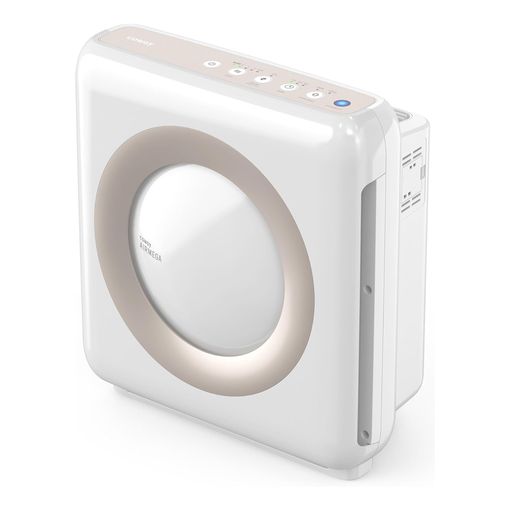
Every product elsewhere in this list makes its own claims about allergen removal. This one has a third party backing it up. The listing states a BAF allergy-charity certification mark. Wirecutter also currently recommends this exact model, as a pick for bedrooms, playrooms and living rooms in its own tested lineup.8 That kind of outside endorsement carries more weight than a manufacturer's own marketing copy, because the outlet publishes its testing method. Real ownership backs it up too. One buyer wrote after using the unit continuously since mid-2022 that it had "been on pretty much continuously 24/7 ever since" purchase. That's over a year of round-the-clock use by the time of the review, with no complaints about performance dropping off.
The Allergy Pick: All The Details
The washable pre-filter is meant to be rinsed every two to four weeks. The HEPA and carbon filters carry a usage-based replacement indicator instead of a fixed timer, so you're not swapping them before they're actually due. A built-in ioniser can be switched on or off, which matters given the EPA's caution about ozone-generating technologies elsewhere in this guide.4 The unit runs quiet on its lower settings. Several reviewers note it gets genuinely loud on high, more like a small fan on full speed than a whisper. There's no companion app on the white model reviewed here. Only a black variant offers that, so check which colour you're ordering if smart-home control matters to you.
MeacoDry Arete One 12L
Damp Rooms That Also Need Purifying
based on 799 Amazon reviews (4.6★), adjusted for performance, build and value
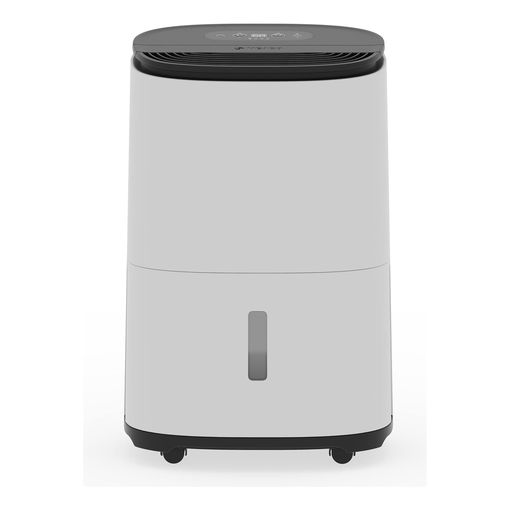
An Honest Look at a Dual-Purpose Machine
This is a dehumidifier first and an air purifier second. It's worth being upfront about that before anything else. Meaco's own product page describes it as adding "a medical-grade HEPA filter for better air purification" to the dehumidifier. It also backs the whole unit with a free five-year warranty, the longest of anything in this roundup by some margin.9 The HEPA stage is genuinely there and genuinely does the filtering job. But it's a bonus bolted onto a machine built to pull moisture out of damp rooms, not a purpose-built purifier competing on CADR with the Levoit or Blueair above. If your actual problem is a damp bedroom, or a flat that struggles with condensation, and you'd also like cleaner air while you're at it, this solves both. If air quality is your only concern, a dedicated purifier elsewhere in this list will do that one job better.
The Dehumidifier-Purifier: All The Details
It's rated to pull up to 12 litres of moisture a day. A dedicated laundry mode runs for six hours to speed up indoor drying, and a night mode dims the display and drops the fan speed. At 35dB on its quiet setting it's genuinely unobtrusive. Several reviewers note the automatic humidity-triggered restarts overnight can be noisier than the steady hum though, worth knowing if you're a light sleeper. One buyer reporting back after a few months of ownership said they'd been "really impressed" with its performance holding up over that time. Another noted it directly replaced an older Meaco unit that had given "very many years of trouble free service," a reasonable proxy for how this generation is likely to hold up. The five-year warranty is a genuine standout. Most air purifiers and dehumidifiers in this price range offer one or two.
Best Air Purifier FAQ
What should I actually look for when buying an air purifier? Two numbers matter more than any marketing claim: the filter's actual HEPA rating, and its Clean Air Delivery Rate (CADR) matched to your room size. The US Environmental Protection Agency's own buying guide puts it simply. Choose a purifier whose CADR is large enough for the room you'll use it in, since a higher CADR means the unit removes particles faster and can serve a larger area.10 A cheaper purifier with an honestly-stated HEPA filter and a CADR sized to your room will outperform an expensive one that's undersized for the space.
What's the most effective type of filtration? True HEPA is the benchmark. In the US, that means a filter independently tested to remove at least 99.97% of particles at 0.3 microns, the hardest particle size to catch. That's the Department of Energy's HEPA standard, which the EPA also cites.11 Europe uses a related but distinct scale, EN 1822, which classifies filters from E10 up to U17. Its "H" tier covers H13 (at least 99.95% efficiency) and H14 (at least 99.995%), both measured at each filter's own most-penetrating particle size rather than a fixed 0.3 microns.12 Any purifier listing "True HEPA," "H13," or "H14" is describing genuinely high-efficiency filtration. A filter marketed only as "HEPA-type" or "HEPA-like" is not held to either standard.
What do doctors and health authorities actually recommend? No health authority hands out purifier brand recommendations. But the EPA's own guide is the closest thing to official consumer advice in this category. It's explicit that no air cleaner removes every pollutant, that portable purifiers don't address the cause of problems like mould, and that gas-removal technologies like plasma or UV aren't proven effective in home purifiers.10 Beyond CADR and genuine HEPA filtration, the clearest independent signal to look for is third-party certification. The Asthma and Allergy Friendly® Certification Mark is one example: it's awarded to products independently tested against a published allergen-reduction standard, not self-certified by the manufacturer.13
Are ionisers or "plasma" air purifiers safe to run? The EPA is direct about this. Ionisers, electrostatic precipitators, and plasma-based air cleaners all have the potential to emit ozone, a lung irritant. No federal health agency has approved any of these technologies for use in occupied rooms.10 If a purifier you're considering markets an ionising or plasma mode as a selling point, treat the HEPA and carbon filtration as the part doing the real work. Check whether the ion function can be switched off.
How big a room can one purifier actually cover? Match the purifier's CADR to two-thirds of your room's square footage as a baseline. That's the rule the Association of Home Appliance Manufacturers (AHAM) publishes for its own CADR-verified purifiers. For wildfire smoke conditions, AHAM recommends a stricter full-room-size match instead.14 Treat "maximum coverage" figures on a listing with some skepticism. Several manufacturers quote a single air change per hour for their largest number. A room that's actually being kept clean typically needs four to five air changes an hour, a much smaller effective coverage area than the headline figure suggests.
How often do air purifier filters need replacing, and what does that cost long-term? Most True HEPA filters in this category need replacing every 6 to 12 months depending on usage and local air quality. That recurring cost is worth factoring into the purchase price before you buy, not after. The Shark NeverChange5 in this roundup is the deliberate exception, rated for five years of use before its filter needs swapping. That's the entire reason it's positioned as the low-maintenance pick here, rather than on filtration power alone.
Do air purifiers actually help with pet dander and pet allergies? Pet dander is a fine, airborne particle in the same size range HEPA filtration is tested against. A genuine HEPA purifier sized correctly for the room will reduce airborne dander along with dust and pollen. It won't remove dander that's already settled into carpet or upholstery, and it won't replace regular cleaning. It addresses what's actively circulating in the air, not what's already on the floor.
Can one purifier handle both allergies and a smoke or cooking-odour problem? Mostly, yes, but check what's actually inside the filter stack rather than assuming. Particle allergens like dust, pollen, and dander are handled by the HEPA layer. Smoke and cooking odours are gas-phase pollutants that need an activated carbon stage to adsorb them instead. Every product in this roundup pairs HEPA with carbon. But the amount of carbon varies a lot, from a thin carbon-infused pre-filter to a dedicated carbon layer, so a unit that's excellent on particles can still leave a cooking smell behind if its carbon stage is minimal.
Do independent allergy certifications on a purifier actually mean anything? More than a manufacturer's own marketing claim, yes. A mark like the BAF seal from a dedicated allergy charity, or the Asthma and Allergy Friendly® mark referenced above, requires independent testing against a published standard before the maker can use the logo. That's a different bar than a bullet point nobody outside the company has checked. It doesn't replace your own judgement about room size and filter type. But it's a genuine signal worth weighting when two products look similar on paper.
Can a dehumidifier double as an air purifier? Some can, but it's worth knowing which job is primary. A handful of dehumidifiers, like the MeacoDry Arete One in this roundup, build in a genuine HEPA filter stage alongside the moisture-removal function. That's a real bonus if you're dealing with a damp room and want cleaner air too. It also saves buying and running two separate appliances. It's not a substitute for a dedicated purifier if air quality, rather than damp, is your main problem. Dehumidifiers generally move far less air than a purpose-built purifier, so their particle-clearing speed won't match a unit designed around CADR first.
The Best Air Purifier for You
The Levoit Vital 100S earns the overall spot on real HEPA filtration, a huge and consistently strong review base, and smart features that are actually easy to use day to day. If you need to cover a bigger open-plan space, the Blueair 211+ Auto has the CADR to back that up. If formaldehyde and other gases are a specific concern, the Dyson TP09 is the only purifier here built to handle them. Pet owners tired of filter-replacement schedules should look hard at the Shark NeverChange5. The Pro Breeze and Xiaomi picks prove you don't need to spend a premium price to get a genuinely HEPA-filtered room, just be honest with yourself about the square footage you're actually trying to clean. Anyone who wants an independently certified pick, rather than a manufacturer's own claims, should look at the Coway Mighty, and if damp is as much of a problem as air quality, the MeacoDry Arete One solves both from a single machine.
-
Levoit Vital 100S-P Smart Air Purifier - Product Specifications ↩︎
-
TechRadar - Dyson Purifier Cool Formaldehyde TP09 review ↩︎ ↩︎
-
Wirecutter - The Best Air Purifiers (Coway Airmega Mighty AP-1512HH) ↩︎
-
EN 1822 - HEPA and ULPA Filter Classification (H13, H14, U15-U17) ↩︎
-
Asthma and Allergy Foundation of America - Certified Asthma & Allergy Friendly Program ↩︎
-
AHAM Consumer Blog - Tips for Choosing the Ideal Portable Room Air Cleaner ↩︎