

Magnetic Phone Mounts: Choosing the Right Type for Your Car

About the author...
Dave has been taking gadgets apart since he was old enough to be told not to. Every pick here is checked against the manufacturer's own documentation rather than the retail listing, and each star rating starts from a product's real Amazon customer score before being adjusted for performance, build quality, features and value. Read more about how ratings are calculated.
Table of contents
-
Key Takeaways (TL;DR)
- Matching Mount Type to Your Car's Layout
- CD-Slot Mounts: A Fading but Still Useful Option
- Does Your Phone Need a MagSafe Ring, or Will Any Metal Plate Do?
- Wireless Charging Through a Mount: Why the Wattage on the Box Rarely Matches What You Get
- Common Mistakes When Choosing a Magnetic Mount
- Where You're Allowed to Mount a Phone, and When You Can Touch It
-
FAQ
- Do I need a MagSafe case, or will a plain metal plate work just as well for holding?
- Will a mount rated for a specific wattage actually charge my phone at that speed?
- Is a vent mount likely to damage an older car's air vents?
- My dashboard has a soft-touch or textured finish. Will a suction mount still hold?
- Where exactly can I mount my phone, and can I touch it at a red light?
- Are CD-slot mounts still worth using?
- The Bottom Line
The right magnetic car phone mount depends on where it fits in your car, not on magnet count. Vent clips suit most dashboards but stress ageing plastic slats, adhesive pads hold the steadiest but can fail in direct summer heat, and suction cups need a smooth surface to seal properly. Whether your phone needs a MagSafe ring or just a plain metal plate depends entirely on what's already built into the phone, not on which mount you buy.
Most advice in this category jumps straight to comparing specific products: which one grips hardest, which one charges fastest, which one costs less. That comparison only makes sense once you know what kind of mount your car and your phone actually need. A vent mount that sits perfectly in a five-year-old hatchback can crack the plastic slat on an older car within a couple of winters. A dash pad that holds fine in a shaded garage can lift clean off a dashboard that bakes in a car park all August. None of that shows up on a spec sheet, and it's the part worth working out before you start comparing brands.
It's also worth being clear about what a magnetic mount actually does for you, because marketing in this category tends to overstate it. A mount doesn't make you a safer driver on its own, and it doesn't have a measurable, proven effect on accident rates. What it genuinely does is keep the phone in a fixed, visible spot instead of sliding around a seat or a cupholder, so glancing at a map or an incoming call doesn't mean picking the phone up to find it. That's a real usability improvement. It isn't the same thing as a proven reduction in crashes, and this guide won't pretend otherwise.
Key Takeaways (TL;DR)
- Vent clips are fastest to fit but load plastic slats that can crack after years on older cars.
- Dash adhesive pads hold the steadiest but can soften or leave a mark in direct summer heat.
- Suction cups need a smooth, non-textured surface to hold a genuine vacuum seal.
- CD-slot mounts still work well if your car has a slot, though few recent cars do.
- MagSafe or Qi2 phones need no plate; everything else needs a stick-on metal disc for a plain magnet mount.
- A mount's charging wattage is a ceiling, not a guarantee since your phone model and adapter set the real number.
- A magnetic mount keeps the phone visible without picking it up which is a usability gain, not a proven safety statistic.
Matching Mount Type to Your Car's Layout
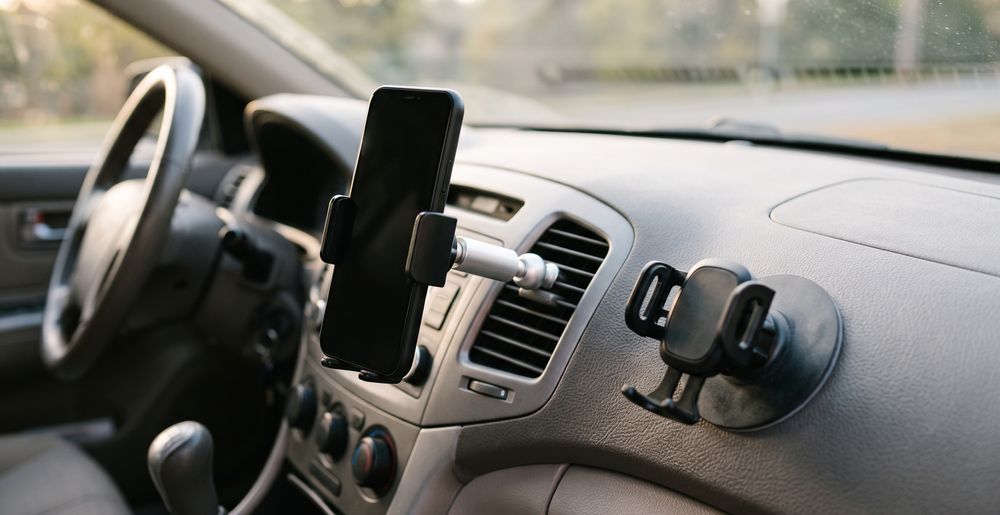
A vent clip is the fastest mount to fit and usually the cheapest to buy, and it works by gripping one of the blades inside an air vent. The risk with this type is mechanical rather than magnetic: every gram of the phone's weight becomes a lever pulling down on a single plastic slat, all day, every day. New cars tolerate this fine because the plastic is still flexible. Cars past six or seven years old are a different story. Years of heat cycling and UV exposure make vent slats brittle, and a slat already stressed by age can crack under a mount that would have been harmless when the car was new. If your vents already feel loose or squeak when you adjust them, treat that as a sign the plastic is past its best, not a reason to buy a heavier mount to compensate.
An adhesive dash mount trades that mechanical risk for a different one: heat. The pad bonds to a fixed spot, and done properly it's the steadiest mounting option here, with nothing to work loose over a pothole. But a dashboard in direct sun for a full afternoon gets hot enough to soften the same adhesive that's supposed to hold firm, and the trim underneath can suffer along with it. Pads left in place for years sometimes lift a patch of soft-touch coating when they finally come off, or leave a permanent shadow where the surface aged differently underneath. If you're set on an adhesive mount, pick a spot the sun doesn't hit directly for most of the day, and expect to reapply it if you ever move it.
Suction mounts are the most surface-dependent of the three. A vacuum seal needs a smooth, non-porous surface to bite into, which is exactly what a glossy centre console or a clean patch of windscreen provides. It's also exactly what a lot of modern dashboards don't provide. Soft-touch and heavily textured finishes, increasingly common on newer cars, are full of microscopic gaps a suction cup can't seal against, and the mount will slowly creep or drop off entirely. Before buying a suction mount, run a hand over the spot you plan to use. If it feels grippy or slightly rubbery rather than smooth, a suction mount is the wrong choice for that spot, whatever its rated holding weight.
None of the three is objectively best. A vent mount suits a newer car where speed of fitting matters more than permanence. A dash pad suits a shaded parking routine where stability matters more than reversibility. A suction mount suits anyone who wants to move the phone between the dashboard and the windscreen, or who simply doesn't want anything stuck down permanently.
Find a product: Best Magnetic Car Phone HoldersCD-Slot Mounts: A Fading but Still Useful Option
CD-slot mounts clip into a car's CD player and use spring tension against the drive mechanism to hold a small arm in place. They sound like a novelty today, and for most drivers they are, mainly because most cars built in the last decade don't have a CD player to clip into. Where a car still has one, though, this type solves every problem the other three mount types run into at once. There's no adhesive to fail in the heat, no vent slat to stress, and no smooth-surface requirement, because the mechanism holds on spring tension against a metal slot rather than any of those.
The catch runs the other way: durability of the slot itself. Repeatedly inserting and removing a CD-slot mount wears the same spring contacts that used to hold a disc steady, and a slot that's had years of physical media through it already may not have much retention margin left. If your car still has a working CD player you never use for actual discs, a CD-slot mount is a genuinely sound option that most buying advice skips over, purely because it doesn't fit neatly into the usual vent-versus-dash-versus-suction comparison. It just isn't relevant to most cars on the road today.
Does Your Phone Need a MagSafe Ring, or Will Any Metal Plate Do?
This is the most common point of confusion in the category, and it comes down to what's actually built into the phone or its case. MagSafe is Apple's implementation of a magnetic alignment system: a ring of magnets built into the phone, or into a MagSafe-compatible case, that snaps to a matching ring in a charger or mount and holds it in a precise, repeatable position. Qi2 is the open industry version of the same idea, standardised by the Wireless Power Consortium so Android phones and third-party accessories can use magnetic alignment too, not just Apple devices. The Consortium describes Qi2 devices as featuring "magnetic attachment technology which aligns devices and chargers perfectly for improved energy efficiency, faster charging, and easier usability."1
If your phone has either of those built in, any magnetic mount works straight out of the box, because the magnets do double duty: they hold the phone in place and they line up the charging coil underneath, if the mount has one. That's the whole reason MagSafe and Qi2 exist as their own category rather than just being "strong magnets" with a brand name attached.
A plain magnetic mount, the kind that isn't MagSafe- or Qi2-certified, works differently and doesn't care about alignment at all. It's simply a strong magnet facing a flat piece of metal, and the metal has to come from somewhere. If your phone doesn't already have magnets built in, that means sticking a thin steel plate to the back of the phone or the case. It's not a downgrade in holding strength: a plain magnet and plate can hold just as firmly as a MagSafe ring, sometimes more firmly. What it doesn't do is align a charging coil, and it looks and feels like exactly what it is, an adhesive metal disc glued to your phone. It can also show through a thin case, stop a case sitting flush against the phone, and rarely comes off cleanly once you've had enough of it.
Most of the confusion comes from product listings that use "magnetic" loosely, describing a mount as MagSafe-compatible when what they actually mean is that it will physically hold any phone with a metal plate stuck on, MagSafe or not. Check whether a mount is explicitly Qi2-certified or built for Apple's MagSafe system if alignment and wireless charging matter to you. If you just want something that holds the phone still, a plain magnet mount with a plate is a perfectly reasonable, usually cheaper choice, and "MagSafe compatible" printed on the box doesn't tell you which kind you're getting.
Wireless Charging Through a Mount: Why the Wattage on the Box Rarely Matches What You Get
A mount advertised as delivering a specific wattage wirelessly is quoting a ceiling set by the charging standard, not a number your phone will necessarily hit. Qi2's baseline spec tops out at 15W, and a newer Qi2 25W revision roughly doubles that on paper.1 Those are the maximums the standard allows a compliant charger and phone to negotiate under ideal conditions, with the right adapter behind them. They aren't a guarantee that any specific phone reaches that number.
Apple's own documentation for its MagSafe Charger makes the gap concrete. How much power an iPhone actually accepts depends on the exact model, not just on whether it supports MagSafe at all. Apple states that iPhone 15 and earlier models charge at up to 15W with a 20W or greater power adapter, that iPhone 16 and iPhone 16 Pro reach 22.5W, and that several newer models reach up to 25W, but only with a 30W or greater adapter behind the mount.2 A mount rated for the lower figure will never deliver the higher one to a phone that supports it, and a mount rated for the higher figure won't push a lower-limited phone past its own ceiling either. The mount, the phone, and the adapter all have to agree, and the lowest number among the three wins.
The car end of that chain is the part buyers overlook most. A mount's charging coil is only as fast as the power reaching it, and that power comes from whatever's plugged into the car's socket or USB port. An old adapter bought years ago for a phone that charged slowly won't suddenly deliver a much higher wattage just because the mount can technically handle it. If fast charging matters to you, the adapter feeding the mount needs to be rated for it specifically, and that's often a separate purchase from the mount itself.
None of this makes wireless charging in a car pointless. It's genuinely convenient to have a phone topped up just by setting it on the mount instead of fumbling for a cable at a red light. It typically charges more slowly than a cable would under real-world conditions, though, and the number printed on the mount's packaging is a best case rather than something to plan around.
Common Mistakes When Choosing a Magnetic Mount
The most common mistake is buying based on magnet count or a phrase like "extra-strong hold" instead of matching the mount type to where it will actually go. A mount with an enormous magnet array is wasted on a vent slat that can't take the phone's weight in the first place, and irrelevant to a dash pad about to bake in direct sun. Match the mount type to the surface first, and treat magnet strength as a secondary comparison between mounts of the same type.
A second mistake is assuming "MagSafe compatible" printed on a mount tells you anything about your own phone. It describes what the mount can hold, not what your phone already has. If your phone doesn't have MagSafe or Qi2 built in, no mount changes that, and you'll still need a metal plate regardless of how the mount is marketed.
A third is chasing a high charging wattage figure without checking whether the phone, the adapter, and the mount actually agree on it, for the reasons above. A mount's spec sheet quotes its own maximum, not what your specific phone will draw, and an underpowered car adapter caps the whole chain regardless of what the mount or phone can technically do.
The last is ignoring where the mount actually sits day to day. A mount that blocks a vent in winter, sits in your direct eyeline, or covers a button or screen you use often will get taken down within a few months, however well it holds a phone. Fit and position matter as much as grip.
Where You're Allowed to Mount a Phone, and When You Can Touch It
Exactly where a phone can be mounted, and what counts as illegal handling once a car is moving, differs by country and sometimes by region within a country, so there's no single rule that applies everywhere this guide is read. What holds almost everywhere is the underlying principle: whatever you mount must not obstruct your view of the road, and touching or holding the phone while the vehicle is in motion is treated as a driving offence in most jurisdictions, regardless of the specific wording used locally. Check the rules that apply where you actually drive rather than assuming a mount position or a hands-free feature that's legal in one country is automatically legal in another.
It's worth understanding why the "no handling while driving" rule exists in the first place, because it isn't only about keeping a hand on the wheel. The World Health Organization's review of driver distraction research found that using a mobile phone while driving makes a crash roughly four times more likely, and that this elevated risk is similar whether the phone is handheld or used hands-free, because the distraction is largely cognitive rather than purely physical.3 That distinction matters for how you use a mount, not just whether you own one. A magnetic mount stops you from having to hold the phone, which removes one kind of risk. It doesn't remove the mental distraction of interacting with the phone at all, which is why setting a route before you drive and leaving the phone alone once you're moving matters more than the mount itself.
FAQ
Do I need a MagSafe case, or will a plain metal plate work just as well for holding?
For holding strength alone, a plain metal plate works just as well as a MagSafe or Qi2 ring, since both rely on a magnet gripping a flat piece of metal. What the plate doesn't do is align a charging coil the way a certified MagSafe or Qi2 ring does, because that alignment is part of what the standard defines.1 If wireless charging matters to you, check for MagSafe or Qi2 certification specifically. If you only want the phone to stay put, a plate is a cheaper and perfectly effective option.
Will a mount rated for a specific wattage actually charge my phone at that speed?
Only if your phone, the mount, and the adapter powering it all support the same figure. Apple's own charging documentation shows that even iPhones vary considerably by model, with older models capped at 15W and newer ones reaching up to 25W, and each tier needs a specific minimum adapter wattage to hit its ceiling.2 The lowest-rated part of that chain sets what you actually get, not the biggest number printed on any single component.
Is a vent mount likely to damage an older car's air vents?
It can, over time, on a car where the vent plastic has already aged. The mechanism is a constant downward lever on one plastic slat rather than anything electrical, so newer cars with flexible plastic tend to handle it fine while vents on older cars, already brittle from years of heat and UV exposure, are more likely to crack under sustained load. A lighter mount, or a mount type that doesn't rely on the vents at all, is the safer choice once a car is several years old.
My dashboard has a soft-touch or textured finish. Will a suction mount still hold?
Probably not reliably. Suction relies on a smooth, non-porous surface to form a proper seal, and textured or soft-touch finishes are full of microscopic gaps that stop that seal forming. Run a hand over the spot you'd use before buying: if it feels grippy or slightly rubbery rather than glass-smooth, a vent clip or adhesive pad is a more dependable choice for that dashboard.
Where exactly can I mount my phone, and can I touch it at a red light?
That depends on the rules where you drive, which vary by country, so there's no single answer that covers every reader. The consistent principle is that a mount must not obstruct your view of the road, and handling the phone while the vehicle is moving is treated as an offence in most places regardless of local wording. The World Health Organization's research also notes that phone-related crash risk stays elevated even in hands-free use, because the distraction is cognitive, not just physical.3 Check your own country's specific rules before assuming a position or a habit is fine.
Are CD-slot mounts still worth using?
Yes, if your car still has a working CD player. They avoid every failure mode the other mount types have, since there's no adhesive to fail in heat, no vent slat under load, and no surface that needs to be smooth. The tradeoff is that repeated use wears the slot's own spring contacts over time, and they're simply not an option in the majority of cars built in the last decade, which don't include a CD player at all.
The Bottom Line
Start with your car, not the mount. A vent clip is quick and cheap but asks a plastic slat to carry weight it wasn't designed for once that slat has aged. A dash pad is the steadiest option but needs a spot the sun doesn't bake all day. A suction mount needs genuinely smooth surface, not just a flat one. From there, check what your phone already has: MagSafe or Qi2 built in means any mount works with no extra step, while anything else needs a metal plate that holds just as well but skips the charging alignment. If wireless charging speed matters, treat the number on the mount's box as a best case set by the standard, not a promise, since your specific phone and adapter decide the real figure. And keep the safety picture honest: a mount makes the phone easier to glance at without picking it up, which is a real convenience, not a substitute for setting your route before you drive and leaving the phone alone once you're moving. Once those decisions are made, comparing specific mounts becomes a much shorter job.