

Best Travel Binoculars for Bright, Steady Compact Views

About the author...
Dave has been taking gadgets apart since he was old enough to be told not to. Every pick here is checked against the manufacturer's own documentation rather than the retail listing, and each star rating starts from a product's real Amazon customer score before being adjusted for performance, build quality, features and value. Read more about how ratings are calculated.
Table of contents
- Key Takeaways (TL;DR)
- How We Choose
- Quick Comparison
- Nikon PROSTAFF P7 8x30 Binoculars
- Vortex Diamondback HD 8x28 Binoculars
- Pentax AD 8x25 WP Roof Prism Binoculars
- Nikon Travelite EX 8x25 Binoculars
- Celestron Outland X 8x25 Compact Roof Prism Binoculars
- Steiner BluHorizons 10x26 Binoculars
- Canon 10x30 IS II Binoculars
- Pentax Papilio II 8.5x21 Binoculars
-
Best Travel Binoculars FAQ
- What do the two numbers in 8x30 actually mean?
- Is higher magnification always better?
- What is exit pupil and why does it matter?
- Roof prism or porro prism?
- How much eye relief do I need if I wear glasses?
- What is the difference between waterproof, fogproof and water resistant?
- Do BAK4 prisms and "fully multi-coated" really make a difference?
- Why do field of view and close focus matter for travel?
- The Best Travel Binoculars for You
The best travel binocular for most people is the Nikon PROSTAFF P7 8x30, because it pairs the widest true field of view in this group with a 3.8mm exit pupil, so the image stays bright when the light goes flat.1 Seven alternatives below trade some of that brightness for less weight, longer eye relief, a tougher shell, or an entirely different optical trick.
Compact binoculars are the one optical product where the headline number on the box is the least useful thing about it. Two pairs both labelled 8x25 can differ by more than a factor of two in usable eye relief, and by a visible margin in brightness once their coatings differ. Nothing in the listing title tells you which is which. What decides the purchase is the set of specs underneath. How big are the objective lenses relative to the magnification? Are the prisms roof or porro? Is every glass surface coated, or only some of them? How far back can your eye sit, how much of the scene do you actually see, and is the body genuinely sealed or merely splash-proof?
One warning before the picks. Compact binoculars attract some of the most dishonest marketing on the internet, and the tell is a huge pair of numbers. Listings promising "40x60" or "30x60" performance from something the size of a phone are not describing 40x magnification and 60mm objectives, because a pocket-sized body physically cannot hold 60mm lenses. Some of those listings are monoculars. Beyond roughly 10x, handheld shake starts to dominate what you see, the field narrows, and the exit pupil shrinks until the view goes dim.2 More magnification on a small binocular actively makes the image worse.
Key Takeaways (TL;DR)
- Exit pupil is objective diameter divided by magnification. Below about 3mm, dusk views go dim.3
- More magnification is not better. Past 10x, shake, a narrow field and a dark image take over.2
- Eye relief decides whether glasses work. Aim for 15mm or more, ideally past 18mm.4
- Roof prisms pack smaller; porro prisms deliver a wide field cheaply.5
- "Waterproof" and "water resistant" are not the same claim. Check for nitrogen purging too.
- Fully multi-coated beats multi-coated. Uncoated glass surfaces quietly throw light away.6
- Close focus matters more than buyers expect for butterflies, museum cases and gallery detail.
How We Choose
Every pair here is judged on the specifications that change what you actually see: exit pupil, real field of view, eye relief, close focus, prism glass and coating level, and sealing. Weight and bulk are weighed against those optics rather than treated as a virtue on their own, since the lightest binocular in any group is usually the dimmest. Every figure quoted comes from the manufacturer's own published specification rather than the retail listing, which in this category is routinely copied from a different model in the same range.
We don't run our own lab tests on these — no dedicated rig, no controlled conditions. What we do instead: read through the verified-purchase reviews in full, not just the star average, weighting the ones written weeks or months after purchase over launch-week first impressions, since that's where wear, reliability problems, and real-world performance gaps actually show up. Where a product genuinely lacks that kind of track record, we say so in its write-up rather than papering over it.
Quick Comparison
Each product's overall rating starts from its real Amazon customer rating, then gets adjusted by up to half a star for real-world performance, build quality, features, and value. Click a product name to jump straight to its full review below.
| Product | Best For | Type | Key Detail | Optics |
|---|---|---|---|---|
|
Nikon PROSTAFF P7 8x30 Binoculars 4.9 |
The brightest, widest view of the eight | Roof prism binocular | 8x30 | 3.8mm exit pupil, phase-corrected roof prisms |
|
Vortex Diamondback HD 8x28 Binoculars 4.9 |
Rough handling and a no-questions warranty | Roof prism binocular | 8x28 | 18mm eye relief, argon-purged body |
|
Pentax AD 8x25 WP Roof Prism Binoculars 4.7 |
Wearing glasses without losing the edges | Roof prism binocular | 8x25 | 21mm eye relief, phase-coated BaK-4 |
|
Nikon Travelite EX 8x25 Binoculars 4.8 |
A sealed pocket pair that shrugs off rain | Porro prism binocular | 8x25 | Waterproof to 2m, aspherical eyepieces |
|
Celestron Outland X 8x25 Compact Roof Prism Binoculars 4.6 |
The widest field for the least money | Roof prism binocular | 8x25 | 8.2 degree field, BaK-4, nitrogen filled |
|
Steiner BluHorizons 10x26 Binoculars 4.6 |
Glare off water, sand and snow | Roof prism binocular | 10x26 | Autobright self-darkening lenses, IPX-4 |
|
Canon 10x30 IS II Binoculars 4.9 |
Steadying the view without a tripod | Image-stabilized porro binocular | 10x30 with optical image stabilizer | Vari-Angle Prism image stabilizer, Porro II prism |
|
Pentax Papilio II 8.5x21 Binoculars 4.9 |
Extreme close-focus macro viewing | Reverse-porro prism binocular | 8.5x21, 0.5m close focus | BaK-4 prism, aspherical lens, 0.5m minimum focus |
Nikon PROSTAFF P7 8x30 Binoculars
Best Overall
based on 340 Amazon reviews (4.6★), adjusted for performance, build and value
What We Love About the Bright All-Rounder
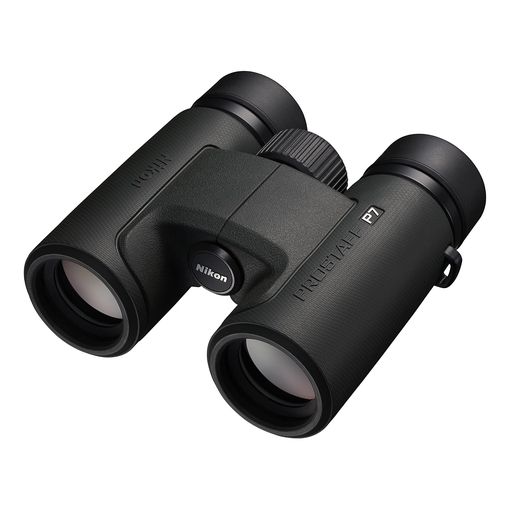
The 30mm objectives are the largest here, and at 8x that gives a 3.8mm exit pupil, comfortably the brightest of the eight once the sun drops behind a ridge.1 The field of view is the other headline: 8.7 degrees, or 152 metres at 1000 metres.1 That is an unusually generous window for a binocular this size, and it is the difference between finding a bird on the wing and hunting for it. Nikon phase-corrects the roof prisms and adds a dielectric high-reflectivity coating, with every lens and prism surface multilayer-coated.1 Its reviews are consistently glowing but skew toward first impressions: none of the ones we found reported back after real weeks or months of ownership, so treat the excellent early praise as exactly that.
The Bright All-Rounder: All The Details
Sealing is proper rather than nominal: O-ring seals, nitrogen fill, and a rating for one metre of water for ten minutes.1 Eye relief runs to 15.4mm, enough for most glasses wearers though not the most generous in this roundup, and close focus is 2.5 metres.1 The tradeoff is on the scales. At 485g it is by some distance the heaviest pair here, roughly 60 percent more than the Pentax, and it will not disappear into a jacket pocket.1 This is a binocular you hang round your neck, not one you forget you packed.
Vortex Diamondback HD 8x28 Binoculars
Best Build and Warranty
based on 324 Amazon reviews (4.6★), adjusted for performance, build and value
Where the Rugged Pick Earns Its Place
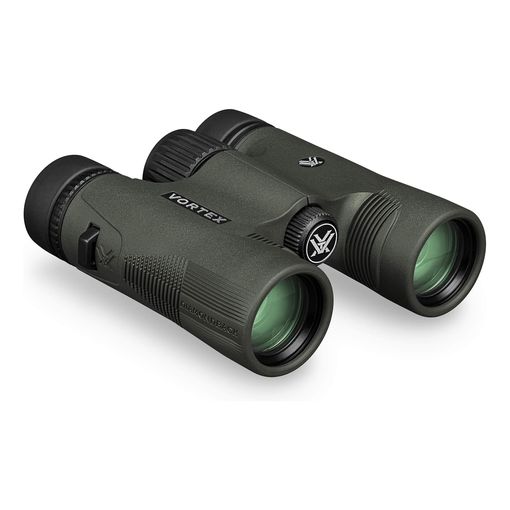
Vortex backs this with an unlimited, unconditional lifetime warranty, which in practice means damage is covered whether or not it was your fault.7 For a binocular that lives in a rucksack lid on rough trips, that changes the maths. The body is argon-purged rather than nitrogen-purged and rated waterproof and fogproof, and the optics use dielectric prism coatings with fully multi-coated lenses.7 Eye relief is a roomy 18mm and close focus comes down to 1.8 metres.7 None of its reviews we found reported back after real weeks or months of ownership, though, so that lifetime warranty is doing more of the reassurance work here than any individual review's timeframe.
Rugged Pick: All The Details
The 28mm objectives sit between the Nikon's 30mm and the 25mm class, giving a 3.5mm exit pupil. Field of view is 6.2 degrees, about 111 metres at 1000 metres, so you see noticeably less at once than through the PROSTAFF P7.7 Weight is 388g, which is lighter than the Nikon but still not pocketable.7 Vortex sells this as a hunting binocular first, and the green armour and squared-off barrels reflect that. If your priority is the widest, brightest view rather than surviving a fall onto rock, the Nikon is the better buy.
Pentax AD 8x25 WP Roof Prism Binoculars
Best for Glasses Wearers
based on 293 Amazon reviews (4.4★), adjusted for performance, build and value
Why the Spectacles-Friendly Compact Made the List
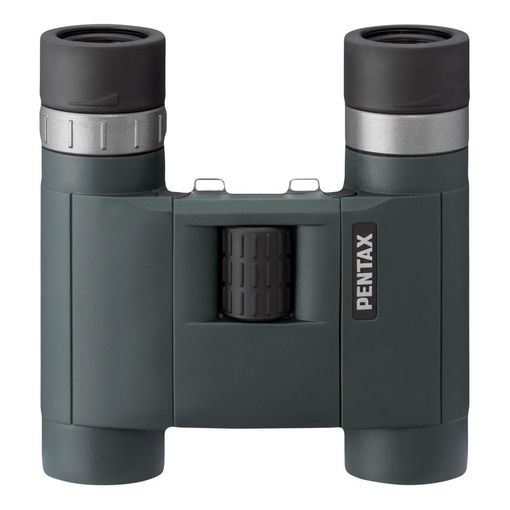
Twenty-one millimetres of eye relief is the longest in this roundup and it solves a problem that ruins compacts for a lot of people.8 Wear glasses through a short-eye-relief binocular and the edges of the image vanish behind a black ring. Here you can leave your specs on, fold the eyecups down, and still see the whole field. Pentax uses phase-corrected BaK-4 prisms with fully multi-coated optics, so it is not trading image quality to get there.8 The honest long-term picture has a catch, though: one owner who'd had a pair almost a year to the day reported dropping them and knocking the alignment out permanently, turning them into a one-eyed instrument. It's a fair warning about the compact double-hinge design's fragility rather than a strike against the optics themselves.
Spectacles-Friendly Compact: All The Details
The body is a fibre-reinforced polycarbonate uni-body, waterproof to one metre and nitrogen filled, and the whole thing weighs 300g.8 Field of view is 6.2 degrees, 108 metres at 1000 metres, and close focus is a useful 1.9 metres.8 The 25mm objectives give a 3.1mm exit pupil, so this is noticeably dimmer than the Nikon PROSTAFF P7 at dusk. Polycarbonate also feels less substantial in the hand than the Vortex's armoured shell, and it has the lowest crowd rating of the eight. What it does better than anything else here is stay comfortable behind glasses.
Nikon Travelite EX 8x25 Binoculars
Best Sealed Pocket Pair
based on 249 Amazon reviews (4.6★), adjusted for performance, build and value
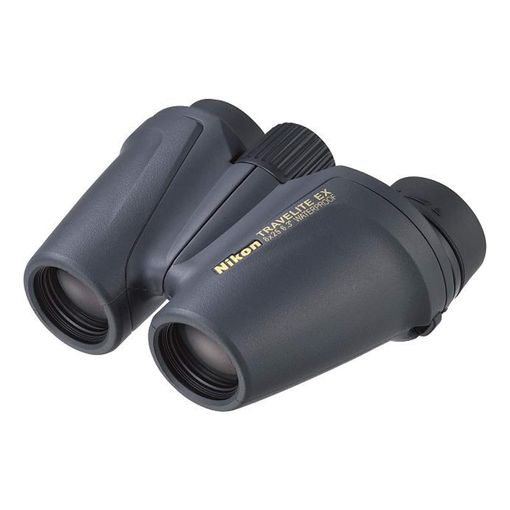
What Works on the Waterproof Pocket Porro
This is the only porro prism design in the group, and it earns its place on sealing. Nikon rates it waterproof to two metres for five minutes with nitrogen inside, the deepest figure of the eight by some way.9 Aspherical eyepiece lenses keep distortion down at the edges, the coatings are multilayer, and eye relief is 15.5mm.9 The reverse-porro layout puts the objectives closer together than the eyepieces, which is why it folds flatter than a conventional porro. None of its reviews we found reported back after real weeks or months of ownership, so its reputation here rests on the wider Nikon track record rather than a dated account of this exact pair.
Waterproof Pocket Porro: All The Details
At 355g in a 116 by 100 by 56mm body it genuinely fits a coat pocket.9 Field of view is 6.3 degrees, 110 metres at 1000 metres, and the exit pupil is 3.1mm.9 Two caveats. Close focus is 2.8 metres, the second worst here, so it is poor for insects and museum cabinets. And Nikon describes the coatings as multilayer without claiming fully multi-coated across every surface, which is the sort of wording gap that usually means exactly what it sounds like. Take it kayaking and none of that will bother you.
Celestron Outland X 8x25 Compact Roof Prism Binoculars
Best Wide Field on a Budget
based on 593 Amazon reviews (4.5★), adjusted for performance, build and value
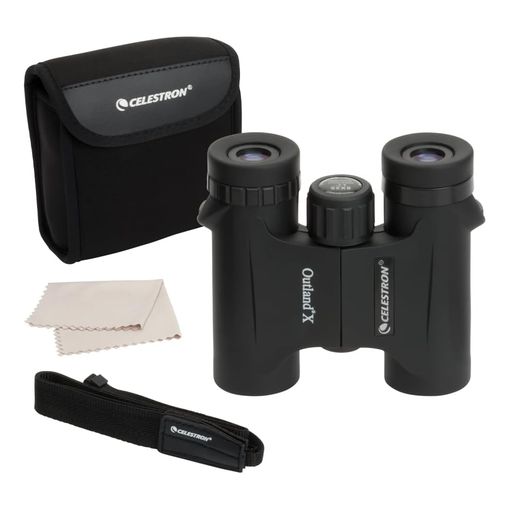
What We Love About the Budget Wide-Angle
Celestron quotes an 8.2 degree field, around 143 metres at 1000 metres, which is the widest in this roundup and remarkable at the price.10 For sports, festivals and open landscape that width is worth more than a fraction of a stop of brightness. The prisms are BaK-4, the body is waterproof and nitrogen filled, the eyecups twist up, and it weighs 326g.10 Celestron covers it with a limited lifetime warranty.10 None of its reviews we found reported back after real weeks or months of ownership, so weigh that lifetime warranty and the brand's long track record more heavily than any individual review's timeframe here.
Budget Wide-Angle: All The Details
Now the bill for that wide field, and it is a steep one. Eye relief is 9.3mm, less than half the Pentax figure, which makes this a poor choice if you wear glasses.10 Close focus is 5 metres, easily the worst here, so anything nearer than across a small garden is out of reach.10 The optics are described as multi-coated rather than fully multi-coated, meaning not every air-to-glass surface gets treated.10 Judged against the Nikon and the Vortex this is a clearly cheaper instrument. Judged on what you pay, the field of view alone justifies it.
Steiner BluHorizons 10x26 Binoculars
Best in Bright Glare
based on 551 Amazon reviews (4.5★), adjusted for performance, build and value
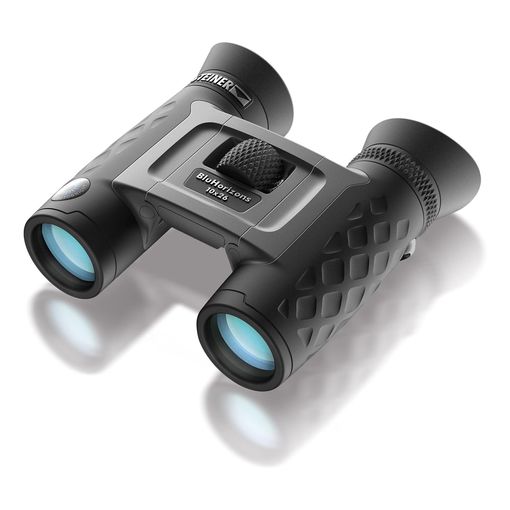
The Glare-Killer: What Sets It Apart
Steiner's Autobright lenses are sunlight-adaptive, darkening as the light intensifies so that reflections off water, sand and snow stop washing the view out.11 Nobody else in this group offers anything comparable, and on a boat or a ski slope it is a genuine advantage rather than a marketing flourish. Fast-Close-Focus gets you from near to far in a short turn of the wheel, eye relief is 12.4mm, and at 300g it ties for lightest here.11 None of its reviews we found reported back after real weeks or months of ownership, so treat the strong early praise as exactly that rather than a proven long-term account.
The Glare-Killer: All The Details
Two things count against it. First, the sealing: Steiner rates the body IPX-4 and states plainly that it is not nitrogen filled, so this is a binocular that shrugs off rain rather than one you can drop in a rock pool.11 Second, the format. Ten times magnification on 26mm objectives yields a 2.6mm exit pupil, among the dimmest here (only the close-focus specialist further down this page runs a shade smaller still). Steiner's own field of view figure is 98 metres at 1000 metres, the narrowest here.11 You will notice both at dusk and you will notice the extra handshake. Buy it for glare, not for low light.
Canon 10x30 IS II Binoculars
Best for Image Stabilization
based on 324 Amazon reviews (4.7★), adjusted for performance, build and value
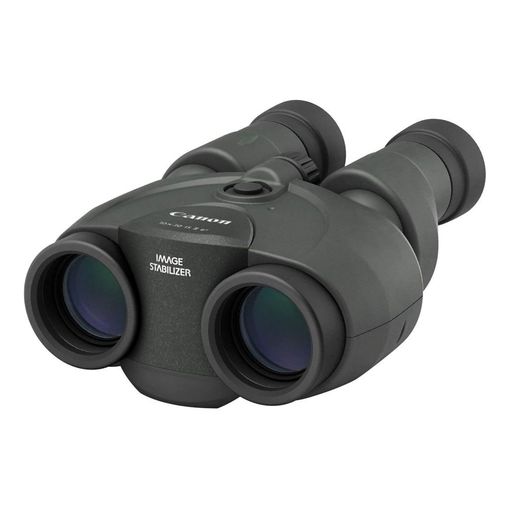
What We Love About the Image-Stabilized Pick
Every other binocular in this roundup asks your hands to hold magnification steady on their own; the Canon 10x30 IS II doesn't. Hold the stabilizer button and a Vari-Angle Prism system inside the body counteracts hand shake in real time, turning a 10x view that would normally drift and blur into something closer to a tripod-mounted image. Reviewers who struggle with shaky hands describe it as transformative rather than merely nice to have, and one owner used it to track a hobby falcon to its perch at a distance no unstabilized 10x pair could have resolved cleanly. The tradeoff for that technology is real: it runs on two AA batteries rather than being fully passive, and none of its reviews we found reported back after real weeks or months of ownership, so treat the enthusiastic early praise as exactly that rather than a settled long-term verdict.
The Image-Stabilized Pick: All The Details
Canon's own spec sheet lists a 105-metre field of view at 1,000 metres, a 3.0mm exit pupil, 14.5mm of eye relief, and a focus range from 4.2 metres to infinity, built around a Porro II prism design with Super Spectra lens coating.12 At 600g it's the heaviest pair in this lineup after the Nikon PROSTAFF P7, and there's no waterproofing rating at all, a genuine gap next to the nitrogen-purged picks elsewhere on this page. Canon rates the stabilizer for around nine hours of continuous use on alkaline AA batteries, so spares are worth packing on a longer trip.12 This is the specialist buy for anyone who finds handheld magnification genuinely shaky, not a blanket upgrade over the cheaper pairs here.
Pentax Papilio II 8.5x21 Binoculars
Best for Macro and Close-Up Viewing
based on 1560 Amazon reviews (4.6★), adjusted for performance, build and value
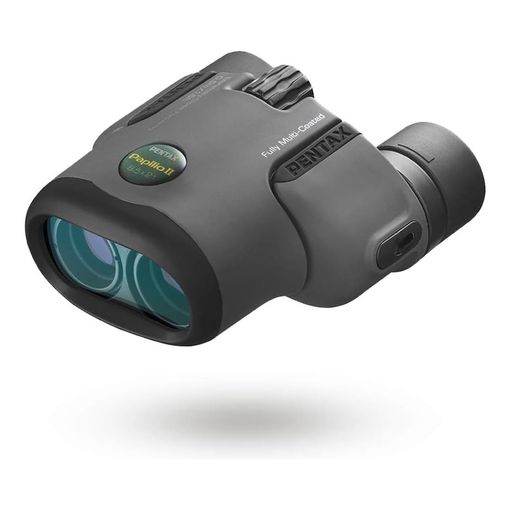
What We Love About the Macro Specialist
Every other binocular in this roundup is built to look far away; the Papilio II is built to do both, and that's the reason it earns a place here. Pentax's rail-based focusing mechanism lets the objective lenses converge as you focus closer, bringing the minimum focus distance down to just 0.5 metres, close enough to study the wing pattern on a butterfly or read fine print on a museum label.13 Nothing else in this lineup gets remotely close to that figure. One buyer's account shows it holds up beyond a first look, too: she travelled with the pair for six weeks and reported they "were not too heavy, though not specifically lightweight," with the case and strap earning a mention as genuinely useful rather than an afterthought.
The Macro Specialist: All The Details
Pentax's own spec sheet lists 8.5x magnification through 21mm objectives, a 105-metre field of view at 1,000 metres, 15mm of eye relief, and fully multi-coated BaK-4 optics with aspherical lens elements for edge-to-edge sharpness.13 At around 290g it's one of the lightest pairs here, and independent diopter adjustment lets each eye be corrected separately. The exit pupil is only 2.5mm, the smallest in this lineup, so low-light performance is the weakest here, and several reviewers note the view dims earlier than a full-size binocular at dusk. Pentax doesn't rate it waterproof either. Buy it for what it does better than anything else on this page, not as an all-rounder.
Best Travel Binoculars FAQ
What do the two numbers in 8x30 actually mean?
The first number is magnification and the second is the effective diameter of the objective lenses in millimetres, so an 8x30 makes things appear eight times closer through 30mm front lenses. The second number matters more than most buyers realise, because it controls how much light the instrument gathers. At the same magnification, a bigger objective gives higher resolution and a brighter image.2 That is the whole reason a 30mm pair outperforms a 25mm pair on a grey afternoon.
Is higher magnification always better?
No, and on compact binoculars it is usually worse. Nikon's own buying guidance puts it flatly: higher magnification brings a narrower field of view, an unstable image from hand movement, and a smaller exit pupil that makes the picture darker.2 Past about 10x, unsupported hands shake enough to blur detail that the extra magnification was supposed to reveal. Treat any pocket binocular advertising figures like 30x or 40x as marketing rather than specification. Check whether it is even a binocular at all, since many such listings turn out to be single-barrel monoculars.
What is exit pupil and why does it matter?
Exit pupil is the diameter of the bright disc of light leaving each eyepiece, and you calculate it by dividing the objective diameter by the magnification: 30 divided by 8 gives 3.8mm.3 It matters because your own pupil opens to roughly 2mm in daylight and up to about 7mm in darkness.3 In bright conditions anything above 2mm looks equally bright, so a small exit pupil costs you nothing. As the light drops and your pupil widens past the binocular's exit pupil, the image starts to look dim.3 That is why the 10x26 in this roundup, at 2.6mm, fades earlier than the 8x30 at 3.8mm.
Roof prism or porro prism?
Porro prisms use a folded light path with two prisms per side and tend to deliver a wide field of view without expensive manufacturing.5 Roof prisms run the light almost straight through. That lets the barrels sit close together for a genuinely slim, pocketable body, but the prisms are much harder to make and adjust accurately.5 A cheap roof prism binocular is therefore usually worse than a cheap porro of the same price, while a good roof prism pair packs far better. Look for phase correction on any roof prism model, since without it fine detail loses contrast.
How much eye relief do I need if I wear glasses?
More than the marketing usually gives you. Eye relief is the distance from the eyepiece surface to the point where the exit pupil forms. Glasses hold your eye further back than that point on short-relief designs, which crops the edges of the view.4 Nikon recommends long eye relief specifically for spectacle wearers.4 As a rule of thumb, 15mm is workable, 18mm is comfortable, and anything under about 12mm will frustrate you. The Pentax AD here offers 21mm and the Celestron Outland X only 9.3mm, which is a bigger practical difference than any spec on the front of either box.810
What is the difference between waterproof, fogproof and water resistant?
Water resistant means the body will survive rain and splashes. Waterproof, when a manufacturer states a depth and a duration, means the sealed body will survive immersion to that limit. Fogproof is a separate claim. It comes from replacing the internal air with dry nitrogen or argon, so no moisture is trapped inside to condense on the inner glass when the temperature swings. A binocular can be water resistant without being gas-purged, which is exactly the case with the Steiner BluHorizons here at IPX-4 and no nitrogen fill.11 If you expect boats, waterfalls or humid mornings, buy a sealed and purged model.
Do BAK4 prisms and "fully multi-coated" really make a difference?
Both are real, but the coating claim matters more. BaK-4 is a barium crown glass with a higher refractive index than the cheaper BK-7 borosilicate. In a well-designed system it gives better image quality, though Celestron itself cautions against treating the usual claims about rounder exit pupils as absolute.6 Coatings are less ambiguous. Fully multi-coated means every air-to-glass surface carries multiple anti-reflection layers. Plain "multi-coated" or "coated" means some surfaces were skipped, and each untreated surface reflects away a slice of the light you paid for.6 Read the wording carefully, because manufacturers choose it precisely.
Why do field of view and close focus matter for travel?
Field of view is how much of the scene you see at once, usually quoted in degrees or as metres visible at 1000 metres. A wide field makes it far easier to find a moving subject, which is why a binocular with a wider view is the better tool for fast-moving birds.2 Close focus is the shortest distance at which the image will sharpen, and it is the specification travellers most often forget. Somewhere between 1.8 and 2.5 metres opens up butterflies, dragonflies, museum cabinets and gallery detail. Five metres, as on the Celestron, closes all of that off.
The Best Travel Binoculars for You
Start with the Nikon PROSTAFF P7 8x30 if optical quality leads your list and you will happily carry 485g for the widest, brightest view of the eight. The Vortex Diamondback HD 8x28 is the one to take somewhere it might get dropped, since the warranty covers damage without argument. Glasses wearers should go straight to the Pentax AD 8x25 WP for its 21mm of eye relief, while anyone planning to be near water will get on best with the deeply sealed Nikon Travelite EX. The Celestron Outland X buys a genuinely wide field for very little, so long as you can live with short eye relief and a distant close focus. The Steiner BluHorizons is a specialist that's brilliant against glare off water and snow, and weaker in low light than most of the others here. If shaky hands are the real problem, the Canon 10x30 IS II solves it directly with image stabilization, and anyone drawn to insects, flowers, or gallery detail up close should skip straight to the Pentax Papilio II's 0.5-metre close focus.