

Best Blood Pressure Monitor for Accurate Home Readings

About the author...
Dave has been taking gadgets apart since he was old enough to be told not to. Every pick here is checked against the manufacturer's own documentation rather than the retail listing, and each star rating starts from a product's real Amazon customer score before being adjusted for performance, build quality, features and value. Read more about how ratings are calculated.
Table of contents
- Key Takeaways (TL;DR)
- How We Choose
- Quick Comparison
- OMRON M3 Comfort Upper Arm Blood Pressure Monitor
- OMRON X7 Smart AFib Upper Arm Blood Pressure Monitor
- Beurer BM 27 Upper Arm Blood Pressure Monitor
- Withings BPM Connect Wi-Fi Blood Pressure Monitor
- A&D Medical UA-611 Upper Arm Blood Pressure Monitor
- OMRON RS7 Intelli IT Wrist Blood Pressure Monitor
- OMRON EVOLV Wireless Upper Arm Blood Pressure Monitor
- Withings BPM Core Blood Pressure Monitor with ECG and Digital Stethoscope
- Braun ExactFit 5 Connect Smart Upper Arm Blood Pressure Monitor
- Best Blood Pressure Monitor FAQ
- The Best Blood Pressure Monitor for You
The best home blood pressure monitor right now is the OMRON M3 Comfort, thanks to its self-adjusting Intelli Wrap Cuff and clinical validation that covers pregnancy and diabetic readings, not just a general population. See the comparison below for how eight other well-reviewed alternatives stack up depending on your priorities.
A home blood pressure monitor can genuinely change how a health condition gets managed. A single reading at a pharmacy or a doctor's office is just a snapshot. A week of readings taken at home, at the same time each day, tells a fuller story. That's why most hypertension guidelines now treat home monitoring as a routine part of diagnosis and ongoing care, not a nice-to-have gadget.
Not every monitor on Amazon deserves that job, though. The gap between a good one and a bad one isn't about screen size or app polish. It comes down to three things: whether the cuff actually fits your arm, whether the device has been tested against a real clinical protocol, and whether it's an upper-arm or wrist design. Those three things matter more than anything else on the spec sheet, and they're where this roundup focuses.
One note before the list: nothing here replaces a conversation with a healthcare provider. A home monitor tracks trends over time and flags when something needs attention. It isn't a diagnostic device on its own.
Key Takeaways (TL;DR)
- Cuff fit matters more than brand or price: a cuff sized wrong for your arm skews every reading it takes.
- Independent validation (an ESH protocol or ISO 81060-2:2018) means more than a manufacturer simply calling a device "clinically tested."
- Upper-arm monitors are the more reliable form factor overall; wrist monitors trade some accuracy for portability and convenience.
- Bluetooth and app syncing help you track trends but don't change the accuracy of any single reading.
- A 3-5 year warranty is a reasonable signal of build confidence in this category.
- No home monitor diagnoses hypertension by itself. A pattern of readings reviewed with a healthcare provider is what actually matters.
- A budget monitor can be accurate if it carries real validation. Paying more doesn't automatically buy a more reliable reading.
How We Choose
Every product here is judged first on one thing: are its accuracy claims backed by a named validation protocol? We check that against the manufacturer's own spec page, not the often-inflated Amazon listing text. From there we weigh cuff design and fit range, build quality, and warranty length. We also weigh useful extras like app syncing or irregular-heartbeat alerts, and how the price compares to the other eight monitors in this list.
We don't run our own lab tests on these — no dedicated rig, no controlled conditions. What we do instead: read through the verified-purchase reviews in full, not just the star average, weighting the ones written weeks or months after purchase over launch-week first impressions, since that's where wear, reliability problems, and real-world performance gaps actually show up. Where a product genuinely lacks that kind of track record, we say so in its write-up rather than papering over it.
Quick Comparison
Each product's overall rating starts from its real Amazon customer rating, then gets adjusted (up to ±0.5) for real-world performance, build quality, features, and value. Click a product name to jump straight to its full review below.
| Product | Best For | Type | Key Detail | Key Spec |
|---|---|---|---|---|
|
OMRON M3 Comfort Upper Arm Blood Pressure Monitor 5.0 |
Most home users wanting validated accuracy | Upper-arm monitor | 22-42cm Intelli Wrap Cuff | Intelli Wrap Cuff, clinical/diabetic/pregnancy validation |
|
OMRON X7 Smart AFib Upper Arm Blood Pressure Monitor 4.9 |
Households wanting heart-rhythm screening built in | Upper-arm monitor | 95.5% AFib screening sensitivity | Bluetooth, AFib screening (95.5% sensitivity, 93.8% specificity) |
|
Beurer BM 27 Upper Arm Blood Pressure Monitor 4.6 |
Budget-conscious buyers who still want a risk indicator | Upper-arm monitor | 120-reading memory across 4 users | Arrhythmia detection, colour-coded WHO risk indicator |
|
Withings BPM Connect Wi-Fi Blood Pressure Monitor 4.4 |
Buyers who want automatic data logging | Upper-arm monitor | ISO 81060-2:2018 validated | Wi-Fi and Bluetooth auto-sync, colour-coded LED display |
|
A&D Medical UA-611 Upper Arm Blood Pressure Monitor 4.8 |
Older adults wanting one-button operation | Upper-arm monitor | 5-year manufacturer warranty | ESH 2010 protocol validation, one-button fuzzy-logic inflation |
|
OMRON RS7 Intelli IT Wrist Blood Pressure Monitor 4.5 |
Travelers needing a compact backup monitor | Wrist monitor | 13.5-21.5cm wrist cuff | Bluetooth, LED positioning sensor, obesity-population validation |
|
OMRON EVOLV Wireless Upper Arm Blood Pressure Monitor 4.8 |
Buyers who want the most discreet, travel-friendly monitor | Upper-arm monitor | Tubeless, all-in-one cuff design | No tubes or wires, Bluetooth, pregnancy validation |
|
Withings BPM Core Blood Pressure Monitor with ECG and Digital Stethoscope 4.4 |
Buyers who want the most clinical feature set at home | Upper-arm monitor | Built-in ECG and digital stethoscope | One-lead ECG, digital stethoscope for valvular disease risk, CE-cleared |
|
Braun ExactFit 5 Connect Smart Upper Arm Blood Pressure Monitor 4.9 |
Households with more than one arm size to fit | Upper-arm monitor | Two cuff sizes included (standard and large) | Bluetooth, WHO colour-coded display, two cuffs in the box |
OMRON M3 Comfort Upper Arm Blood Pressure Monitor
Best Overall Blood Pressure Monitor
based on 8058 Amazon reviews (4.7★), adjusted for performance, build and value
What We Love About the Overall Pick
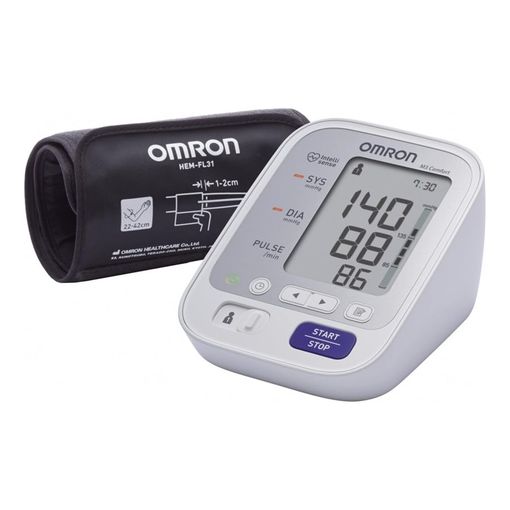
Most accuracy problems with home monitors trace back to one thing: the cuff isn't wrapped correctly. OMRON's Intelli Wrap Cuff sidesteps that. It measures accurately no matter exactly where on the upper arm it lands, which matters more than any other single feature on this list. It's also validated for use during pregnancy and by people with diabetes. Those are groups many cheaper monitors simply haven't been tested on1.
Nearly 8,000 reviews at a 4.7-star average is a genuinely large sample for this category. The pattern in that feedback is consistent: people trust the numbers it gives them. One owner reporting back nearly a year after buying it said they'd used it "well over 250 times" without changing the original batteries, then updated the review over a year later to confirm the same batteries had lasted roughly 750 readings.
Overall Pick: All The Details
The M3 Comfort uses OMRON's IntelliSense technology to inflate to the right pressure automatically, rather than overshooting. It stores 60 readings each for two separate users, handy for a household where two people track their own numbers. There's no Bluetooth on this model, so readings have to be logged by hand or read straight off the display. That's the main thing it gives up next to the pricier X7 Smart below. It comes with a 5-year manufacturer warranty and the same Intelli Wrap Cuff, fitting 22-42cm arms1.
OMRON X7 Smart AFib Upper Arm Blood Pressure Monitor
Best for AFib Screening
based on 2460 Amazon reviews (4.6★), adjusted for performance, build and value
Why the AFib Screening Earns Its Place
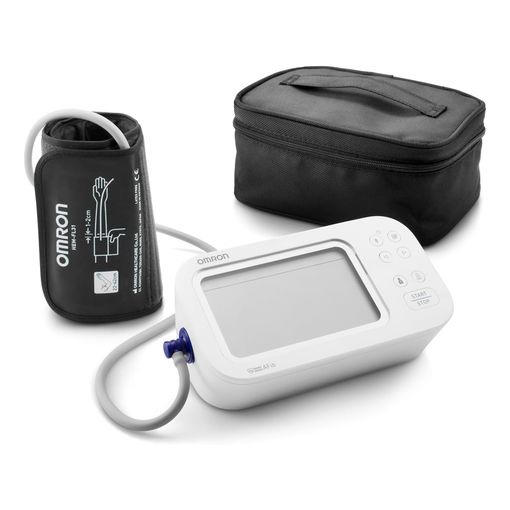
Every time the X7 Smart takes a reading, it also screens for signs of atrial fibrillation. That's an irregular heart rhythm that often has no symptoms, and it's a known stroke risk factor. OMRON states the screening runs at 95.5% sensitivity and 93.8% specificity against clinical reference testing. The brand is upfront that a flag on the device is "a potential finding," not a diagnosis1. That distinction matters: it's a reason to call a doctor, not a replacement for one.
Bluetooth syncing to the OMRON Connect app rounds it out. It stores up to 100 readings per user for two people, building a real trend line instead of a stack of numbers on paper. One buyer who'd been using it for "several weeks now" called it one of the most capable upper-arm monitors she'd tested, with accuracy that held up consistently against clinic readings.
AFib Screening: All The Details
Physically, the X7 Smart shares its Intelli Wrap Cuff (22-42cm) and 5-year warranty with the cheaper M3 Comfort. So you're mainly paying for the AFib screening and the connected app layer, not a different core measurement mechanism. It's also validated for pregnancy and diabetic use, the same as the M31. At 4.6 stars across roughly 2,500 reviews, it's rated slightly below the M3 Comfort, and it sits at the premium end of this lineup. That's the honest tradeoff for the extra screening feature.
Beurer BM 27 Upper Arm Blood Pressure Monitor
Best Budget Blood Pressure Monitor
based on 31250 Amazon reviews (4.5★), adjusted for performance, build and value
The Budget Pick's Strongest Case
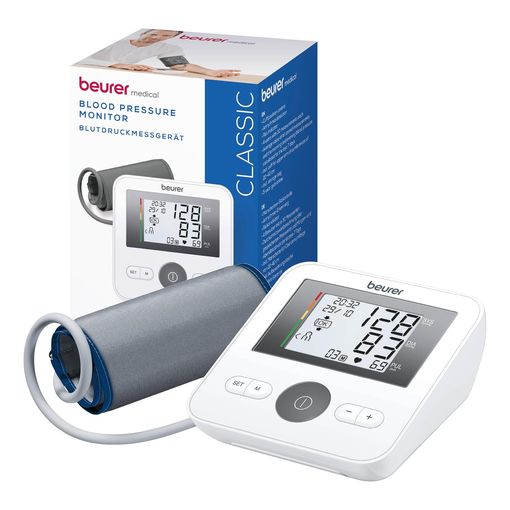
With over 31,000 reviews, the BM27 has the largest review base of anything in this roundup. A 4.5-star average across that many buyers is hard to dismiss. It covers the basics well: a WHO-style colour-coded risk indicator, arrhythmia detection, and profiles for four separate users with 30 stored readings each.
Beurer describes the BM27 as clinically validated on its own product page. Unlike the OMRON and Withings devices in this list, though, we couldn't find an independent third-party validation listing for this specific model. That's worth knowing going in, even if the real-world review pattern is solid: one buyer said simply that she'd "been using it for years now and I always get an accurate reading," even checking it against her GP's own machine.
Budget Pick: All The Details
The cuff covers a 22-42cm range, the same span as the pricier OMRON monitors above, and the whole unit comes with a 5-year guarantee2. There's a companion HealthManager Pro app, but it works by scanning the display with your phone's camera rather than syncing over Bluetooth. That's a workable but distinctly older-generation approach next to the Withings and X7 Smart. For someone who wants an accurate, no-frills monitor and doesn't care about automatic syncing, it's a sensible place to spend less.
Withings BPM Connect Wi-Fi Blood Pressure Monitor
Best Smart, Connected Monitor
based on 15574 Amazon reviews (4.2★), adjusted for performance, build and value
A Genuinely Useful App, For Once
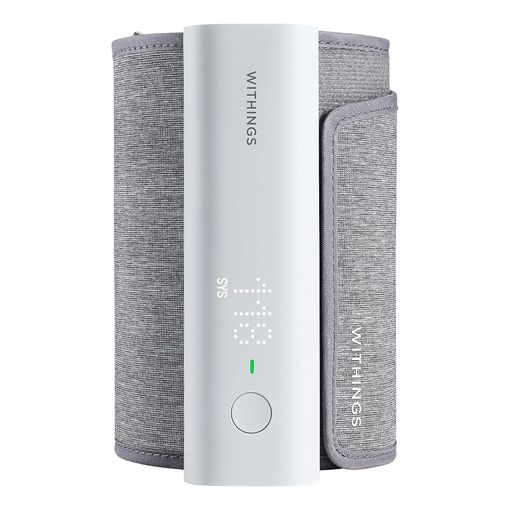
Most "smart" health gadgets bolt an app onto a device that would work fine without it. The BPM Connect is different. Readings sync automatically over Wi-Fi and Bluetooth to the Health Mate app the moment you take them, with no manual scanning or button-pressing required. From there they can be shared directly with a healthcare provider. A peer-reviewed validation study tested it against the AAMI/ESH/ISO Universal Standard in a general adult population, and found mean errors of 0.6 mmHg systolic and 2.1 mmHg diastolic, well inside the protocol's accuracy threshold3.
It's a compact, fabric-wrapped design that looks more like a piece of home tech than a medical device. Some buyers will like that; others will find it unnecessary. One reviewer who'd used it "for months" by the time she wrote her review said it had helped get her diagnosed with high blood pressure and let her track treatment progress with confidence.
Smart Monitor: All The Details
At 4.2 stars, the BPM Connect carries the lowest Amazon rating in this lineup. The review pattern points to a real reason: initial Wi-Fi setup is a common sticking point, and the device leans on its companion app more than any other monitor here. That won't suit everyone. The one-size cuff covers the same 22-42cm range validated in that accuracy study3, and it's cleared for medical use in both the US and EU markets. If reliable app syncing is the priority, the tradeoff is worth it. If you just want a number on a screen, it's more device than most people need.
A&D Medical UA-611 Upper Arm Blood Pressure Monitor
Best for Simplicity and Longevity
based on 51107 Amazon reviews (4.6★), adjusted for performance, build and value
One Button, and Not Much Else
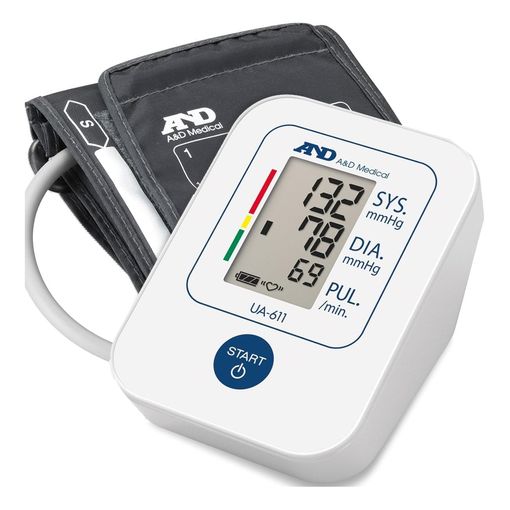
A&D Medical isn't a household name the way OMRON is. But it's one of the few other brands that shows up consistently on formal validated-device listings. That says more about its reliability than brand recognition ever could. The UA-611 strips a blood pressure monitor down to one button: press it, sit still, get a number. There's no app, no Bluetooth, and no colour touchscreen. For a lot of older users, or anyone who just wants the device to work without a setup process, that's the whole appeal.
With over 51,000 reviews at a 4.6-star average, it's the most-reviewed product in this roundup by a wide margin. One reviewer who'd been using it for "about a year" called it accurate and easy to use, with reasonable battery life to match.
Simplicity Pick: All The Details
The standard cuff fits 22-32cm arms, narrower than the OMRON and Beurer monitors above. A separate large cuff covering 31-45cm is available for bigger arms4. It's validated to the ESH 2010 protocol and includes irregular heartbeat detection alongside a WHO risk classification indicator. The monitor itself carries a 5-year warranty, though the cuff and batteries are excluded from that cover. That's a distinction worth reading the small print on4. What it doesn't do is track trends or store more than 30 readings, so anyone who wants a longer memory or automatic logging should look elsewhere on this list.
OMRON RS7 Intelli IT Wrist Blood Pressure Monitor
Best Wrist Monitor for Travel
based on 3482 Amazon reviews (4.4★), adjusted for performance, build and value
The Case for Going Wrist-Worn
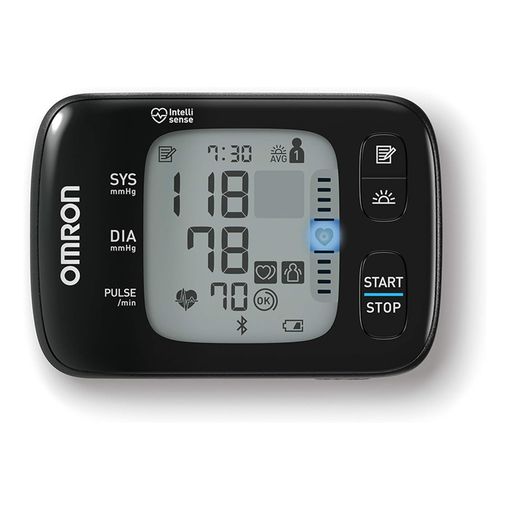
Wrist monitors exist because upper-arm cuffs aren't practical for everyone. If a standard cuff doesn't fit comfortably, or you travel enough that packing a full-size monitor is a hassle, a wrist device like the RS7 is a legitimate option, not just a compromise. It uses an LED positioning sensor that lights up once your wrist is at heart level, tackling the biggest source of wrist-monitor error directly. It's also been validated in an obese population specifically, a group where upper-arm cuffs can be harder to fit correctly5.
That said, this is the one product in this roundup we'd steer most buyers away from as a primary monitor. None of its reviews report back after real ownership time, either, so its long-term track record is thinner than the upper-arm monitors above it in this list.
Wrist Monitor: All The Details
Health authorities are consistent on this point: upper-arm devices are generally considered more reliable than wrist monitors. That's largely because wrist position relative to the heart is easy to get wrong, even with a positioning aid6. The RS7 fits 13.5-21.5cm wrists, stores 100 readings for each of two users, and syncs over Bluetooth to the OMRON Connect app, the same ecosystem as the X7 Smart5. Its 4.4-star rating, from a smaller pool of around 3,500 reviews, reflects a device that does its specific job well. It just isn't the best choice for everyday primary monitoring. Keep it as a secondary or travel monitor rather than your household's main one.
OMRON EVOLV Wireless Upper Arm Blood Pressure Monitor
Best for a Discreet, Travel-Friendly Design
based on 2310 Amazon reviews (4.6★), adjusted for performance, build and value
Why the All-in-One Cuff Stands Out
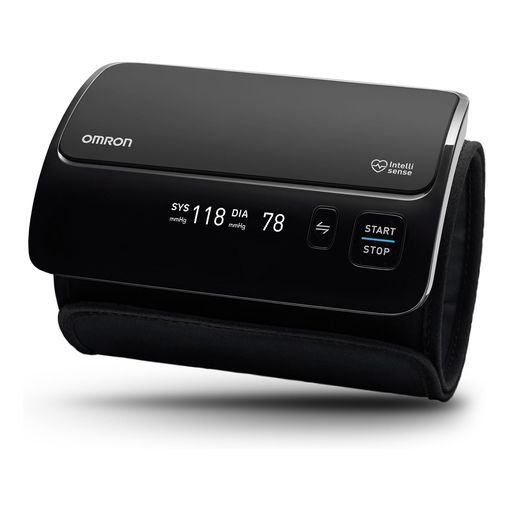
Every other upper-arm monitor in this list separates the cuff from a tabletop or handheld display unit, connected by a length of tubing. The EVOLV folds both into a single wrap that slides onto the upper arm, with the reading displayed directly on the cuff itself. There's genuinely nothing to set down, tangle, or lose track of, which matters if you're packing a monitor for travel or just want one less thing cluttering a bathroom shelf. It shares the same Intelli Wrap Cuff and pregnancy validation as the M3 Comfort above, and it also flags an irregular heartbeat during a routine reading, though without the branded AFib sensitivity figures OMRON publishes for the X7 Smart7. We couldn't find a review in its own listing that established a genuine multi-week or multi-month ownership timeframe; most feedback we found covers first impressions and setup, not sustained use, so treat that as an honest gap rather than a track record.
All-in-One Design: All The Details
The EVOLV's cuff covers the same 22-42cm range as the rest of the OMRON monitors here and carries the same 5-year warranty7. It syncs to the OMRON Connect app over Bluetooth, though the device only supports one user, so it isn't the pick for a two-person household. One recurring gripe in its review pattern is that the rigid, curved shape can be a little awkward to slide up a bare arm before the fabric fastener grips, and it runs on disposable AAA batteries rather than a rechargeable cell. Neither is a dealbreaker, but they're worth knowing before you buy the sleekest-looking monitor in this lineup.
Withings BPM Core Blood Pressure Monitor with ECG and Digital Stethoscope
Best for the Most Clinical Feature Set
based on 2045 Amazon reviews (4.3★), adjusted for performance, build and value
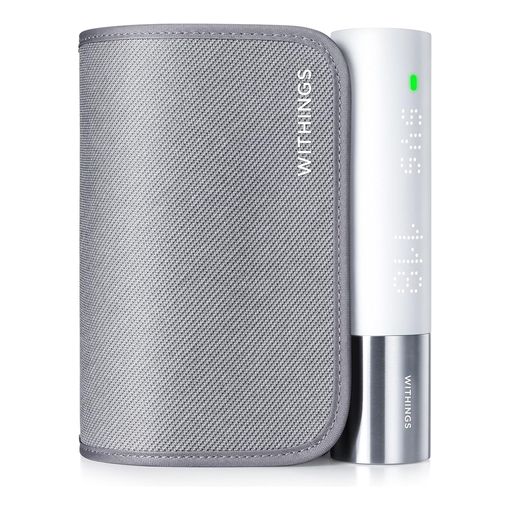
Three Devices in One Cuff
No other product in this roundup does what the BPM Core attempts: alongside a standard blood pressure reading, it records a one-lead ECG from an electrode in the cuff and one on the handheld tube, screening for atrial fibrillation, and it runs a 20-second digital stethoscope check against valvular heart disease risk. Both extra functions are CE-cleared as medical device features, though a US FDA clearance was still pending at the time of writing89. One buyer who tracked roughly seven weeks of twice-daily readings on a single charge reported the battery was "still showing 68% full," a genuinely reassuring sign for a device built around a rechargeable cell rather than replaceable batteries. The blood pressure and ECG readings draw consistent praise in its review pattern. The stethoscope function is the honest weak point: several buyers report it frequently returns an inconclusive result, and getting a usable recording often takes some trial and error with positioning against bare skin.
Clinical Feature Set: All The Details
The BPM Core is the most expensive monitor in this lineup by a wide margin, and that price buys genuinely different hardware rather than just a nicer app. It charges over Micro-USB rather than USB-C, a small but dated choice on a device at this price point. Wi-Fi and Bluetooth sync send every reading, ECG trace, and stethoscope result to the Health Mate app automatically, and reports can be shared directly with a healthcare provider as a PDF. It's a genuinely useful device for someone actively monitoring more than blood pressure alone, but the stethoscope's inconsistency means it shouldn't be the reason you buy it.
Braun ExactFit 5 Connect Smart Upper Arm Blood Pressure Monitor
Best Value Connected Monitor
based on 6336 Amazon reviews (4.6★), adjusted for performance, build and value
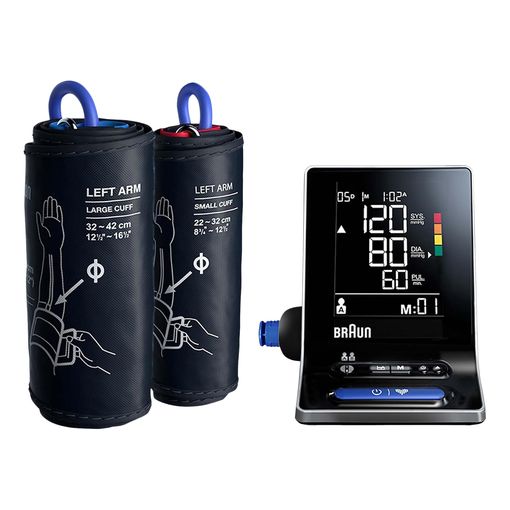
A Familiar Name at a Sharper Price
Braun's healthcare division doesn't have OMRON's specific track record on clinical validation listings, but it's a recognised brand backed by a real manufacturer (Kaz Europe, a Helen of Troy company) rather than a drop-ship label, and the ExactFit 5 Connect undercuts most of the Bluetooth-connected monitors in this list while still bringing Bluetooth sync, a WHO-style colour-coded display, and irregular heartbeat detection10. One buyer who'd used it "for a few weeks" called it the best blood pressure machine they'd tried, matching their doctor's office readings closely. A second reviewer's two-week follow-up was more mixed: comparing it against a paramedic's own monitor during a family medical situation, they found the Braun reading roughly 20% higher than the professional device on that occasion. That's a single account rather than a pattern across its 6,000-plus reviews, but it's a fair reason to treat any single reading as a data point, not a diagnosis, regardless of which monitor gives it to you.
Value Connected Pick: All The Details
The standout practical feature here is that it ships with two cuffs, standard and large, in the box, rather than making you buy a second cuff separately if two household members have very different arm sizes10. It stores 60 readings for two users, syncs to the Braun Healthy Heart app over Bluetooth, and includes the same colour-coded WHO-style risk display as the pricier OMRON and Withings monitors above. For a household that wants Bluetooth logging and a properly-fitting cuff for more than one person, without paying OMRON or Withings pricing, it's the strongest value pick in this roundup.
Best Blood Pressure Monitor FAQ
What's the real difference between upper-arm and wrist monitors, and which is more accurate? Upper-arm monitors measure at the brachial artery. That's a large vessel close to the heart, and it gives a stable, well-studied reading. Wrist monitors measure a smaller artery further from the heart. The reading shifts if the wrist isn't held level with the heart during measurement. Cleveland Clinic states that healthcare providers generally recommend upper-arm monitors as the more reliable standard. Wrist monitors can still be appropriate for people who can't get a good fit with an upper-arm cuff6.
Which type do healthcare providers actually recommend? For most people, an upper-arm monitor. The general clinical guidance is to reach for a wrist or finger device only when an upper-arm cuff genuinely doesn't fit or can't be used comfortably. Even then, choosing a specifically validated wrist model like the RS7 above still matters6.
What does "clinically validated" actually mean, and how do I check it? It means the device has been tested against a recognised protocol, such as an ESH standard or the AAMI/ESH/ISO Universal Standard (ISO 81060-2:2018). That protocol compares the device's readings against a manual reference measurement across a real group of people. In the US, the AMA-backed Validated Device Listing at validatebp.org independently reviews manufacturer testing data before adding a device. That's a stronger signal than a manufacturer simply stating "clinically validated" without naming the protocol11.
Why do OMRON and A&D Medical show up so often on validated lists? Both have invested heavily in formal clinical validation across their ranges. That includes testing on less commonly studied groups like pregnant users, people with diabetes, and people with obesity. It's a real, verifiable reason they dominate this category, not just market share.
What cuff size do I actually need? Measure around your bare upper arm at the midpoint between your shoulder and elbow. Most standard cuffs cover roughly 22-42cm, which fits most adults. A cuff that's too small will read artificially high, and one that's too large will read artificially low. If you're outside that range, check for a specific large or small cuff option before buying.
Can a home monitor diagnose high blood pressure on its own? No. A single reading should never be treated as a diagnosis. Blood pressure naturally varies through the day, and the exact numbers used to define normal, elevated, and hypertensive readings differ slightly between guideline bodies and countries, so check the categories your own healthcare provider uses12. What is consistent everywhere is the extreme end: a reading persistently at or above 180/120 mmHg is treated as a hypertensive emergency and needs immediate medical attention, not a wait-and-see approach13.
How often should I check my blood pressure at home? That's a question for whoever is managing your care. It depends on whether you're monitoring an existing diagnosis, checking after a medication change, or just tracking a baseline. What matters more than frequency is consistency: same arm, same time of day, seated and relaxed for a few minutes beforehand.
Does a connected monitor pair well with other health gear? If you already use a smart scale or a fitness tracker from the same ecosystem, an app-connected monitor like the Withings BPM Connect or OMRON X7 Smart keeps everything in one place. That makes patterns easier to spot, and easier to share as a full picture with a healthcare provider rather than a single number.
The Best Blood Pressure Monitor for You
The OMRON M3 Comfort earns the overall pick on the strength of its self-correcting cuff and its validation for pregnant and diabetic users, not just a general population, at a price that undercuts the fancier X7 Smart. Buyers who specifically want AFib screening should pay the premium for the X7. Anyone on a tighter budget can trust the Beurer BM27's huge review base or the A&D UA-611's stripped-down reliability. The Withings BPM Connect suits a household already inside its app ecosystem, while its pricier sibling the BPM Core is worth the extra outlay only if the ECG and stethoscope functions genuinely matter to you. The OMRON EVOLV is the one to pick for the most discreet, tube-free design, and the Braun ExactFit 5 Connect is the strongest value pick among the connected monitors, especially for a household needing two cuff sizes. The OMRON RS7 wrist monitor is worth owning only as a backup or travel device, not a primary one. Whichever you choose, treat it as a tool for tracking trends, and talk to a healthcare provider about what the numbers actually mean for you.
-
OMRON X7 Smart Blood Pressure Monitor | OMRON UK ↩︎ ↩︎ ↩︎ ↩︎
-
Accuracy of the Withings BPM Connect Device for Self-Blood Pressure Measurements in General Population - PMC ↩︎ ↩︎
-
UA-611 BIHS Approved Upper Arm Blood Pressure Monitor - A&D Instruments UK Medical ↩︎ ↩︎
-
OMRON RS7 Intelli IT Blood Pressure Monitor | OMRON UK ↩︎ ↩︎
-
Do Wrist Blood Pressure Monitors Work? - Cleveland Clinic ↩︎ ↩︎ ↩︎
-
BPM Core - Frequently asked questions about electrocardiogram (ECG) | Withings Support ↩︎
-
BPM Core - Frequently asked questions about digital stethoscope | Withings Support ↩︎
-
BP monitoring you can count on - list of validated devices grows | American Medical Association ↩︎
-
Table 1, Blood Pressure Classifications - Screening for Hypertension in Adults - NCBI Bookshelf ↩︎