

Best Stud Finder for Safe and Accurate Wall Drilling

About the author...
Dave has been taking gadgets apart since he was old enough to be told not to. Every pick here is checked against the manufacturer's own documentation rather than the retail listing, and each star rating starts from a product's real Amazon customer score before being adjusted for performance, build quality, features and value. Read more about how ratings are calculated.
Table of contents
- Key Takeaways (TL;DR)
- How We Choose
- Quick Comparison
- Bosch Professional GMS 120-27 Wall Scanner
- Franklin Sensors ProSensor 710+
- Franklin Sensors ProSensor M210
- CH Hanson 03040 Stud 4 Sure Magnetic Stud Finder
- The StudBuddy Magnetic Stud Finder
- Kreg KMM1000LZ Magnetic Stud Finder with Laser-Mark
- Zircon MultiScanner A250c
- Walabot DIY 2
- HANMATEK SF1 4-in-1 Stud Finder
- Best Stud Finder FAQ
- The Best Stud Finder for You
The best stud finder overall is the Bosch Professional GMS 120-27, thanks to its combination of wood, metal and live-wire detection modes in one shock-resistant, IP54-rated body from a brand with a genuine service and warranty network. See the comparison below for how 8 other well-reviewed alternatives stack up depending on your wall type and budget.
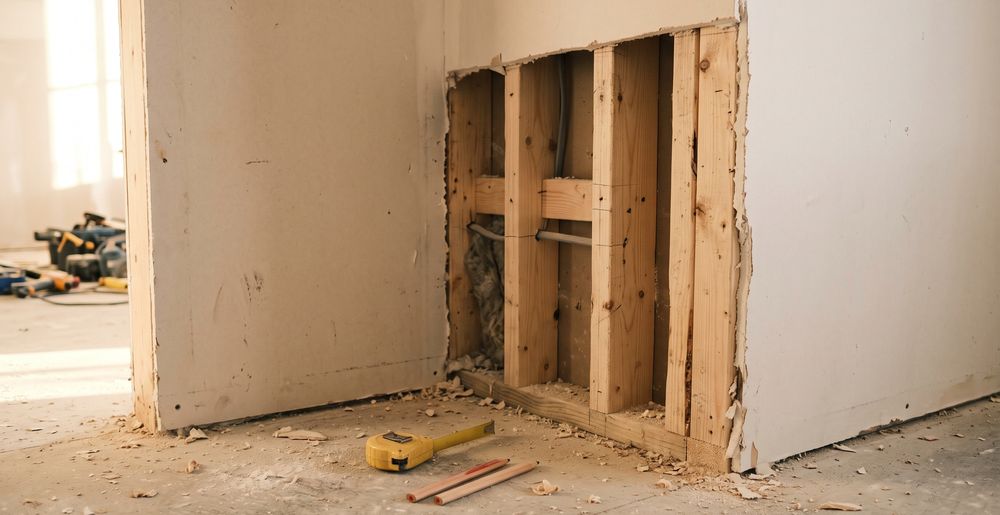
A stud finder solves one specific problem. It tells you what's hiding behind a flat wall before you drill into it. That matters whenever you're hanging a TV bracket, a set of shelves, a cabinet, or anything heavier than a picture frame. Plasterboard and drywall alone won't hold much weight. Get it wrong and one of two things happens. You miss the timber frame, and the fixing eventually pulls out. Or you hit a pipe or a live cable, which ranges from an annoying repair bill to a genuine safety hazard.
Not every stud finder works the same way, and that's the main thing worth understanding before buying one. Magnetic models find the metal fasteners holding your wall board to the frame. That's simple, and it never loses accuracy from a flat battery. But it only works where a nail or screw happens to be nearby. Electronic scanners read changes in material density as you sweep them across the wall. This can locate the stud itself rather than just a fastener, but it's more easily confused by uneven walls, old plaster, or paint that isn't perfectly flat. A newer category, visual imaging scanners, pairs a radar-like sensor with a smartphone app. Instead of a beep or a light, you get a picture of what's inside the wall. None of these methods is flawless. The products below are honest about where each one struggles.
Key Takeaways (TL;DR)
- Sensor count beats screen graphics. Electronic scanners with more simultaneous sensors give a clearer read of a stud's full width, not just a single point.
- Magnetic finders can't fail electronically, but they only find studs that have a nearby nail or screw, not the timber itself.
- Plaster and lath-and-plaster walls need real depth. A shallow StudScan mode built for drywall can miss studs behind older solid plaster completely.
- Live-wire warnings are a bonus, not a certified safety device. Treat a positive reading as a reason to stop and check further, never as proof a wall is safe.
- Visual imaging tools cost far more but are the only type here that shows pipes, wires and studs on one live picture instead of a single reading.
- Calibration habits matter as much as the hardware. Most false readings in owner reviews trace back to skipping the recalibration step, not a faulty unit.
- No stud finder here is right 100% of the time on every wall. For load-bearing fixings or heavy TV mounts, cross-check with a second method before committing to a hole.
How We Choose
We judged every stud finder on four things: how well it actually locates what it claims to, how it copes with different wall types (simple drywall versus older plaster and lath), how much genuinely useful extra functionality it adds, and how that stacks up against its price within this lineup.
We don't run our own lab tests on these. There's no calibrated test wall in our workshop with studs, pipes and wires set at known depths. Instead, we read through the verified-purchase reviews in full, not just the star average. We give more weight to reviews written weeks, months or years after purchase than to launch-week first impressions, since that's where battery reliability, storage durability and real-world wall performance actually show up. We also check specific depth, sensor and safety claims against each manufacturer's own product pages rather than trusting Amazon bullet points alone, since those are sometimes copied across different models in a brand's range. Where a product genuinely lacks a long-term track record in its own reviews, we say so below rather than papering over it.
Quick Comparison
Each product's overall rating starts from its real Amazon customer rating, then gets adjusted (up to ±0.5) for real-world performance, build quality, features, and value. Click a product name to jump straight to its full review below.
| Product | Best For | Type | Key Detail | Key Spec |
|---|---|---|---|---|
|
Bosch Professional GMS 120-27 Wall Scanner 4.5 |
Buyers wanting one trusted all-round scanner | Wall scanner | 120mm depth | IP54, wood/metal/live-wire modes |
|
Franklin Sensors ProSensor 710+ 4.5 |
Finding multiple studs in one pass | Multi-sensor stud finder | 13 sensors | 13-sensor simultaneous LED array |
|
Franklin Sensors ProSensor M210 4.5 |
Multi-sensor accuracy plus a wire warning | Multi-sensor stud finder | 13 sensors + AC | 13 sensors, live-wire warning, level |
|
CH Hanson 03040 Stud 4 Sure Magnetic Stud Finder 4.9 |
Simple, battery-free stud finding | Magnetic stud finder | No batteries | Rare-earth magnets, built-in level |
|
The StudBuddy Magnetic Stud Finder 4.6 |
The smallest, cheapest stud finder | Magnetic stud finder | Single magnet | Twin rare-earth magnets, no level |
|
Kreg KMM1000LZ Magnetic Stud Finder with Laser-Mark 4.7 |
Magnetic finding with laser marking | Magnetic stud finder | Laser-Mark | Magnets plus Class 2 laser marker |
|
Zircon MultiScanner A250c 4.4 |
Plaster and lath-and-plaster walls | Wall scanner | 38mm DeepScan | DeepScan to 38mm, dedicated AC Scan mode |
|
Walabot DIY 2 4.1 |
Seeing what's actually behind the wall | Visual imaging scanner | 10cm imaging | App-based radar imaging to 10cm |
|
HANMATEK SF1 4-in-1 Stud Finder 4.3 |
Budget-friendly multi-mode scanning | Wall scanner | 4-in-1 modes | 4-in-1 modes, backlit LCD readout |
Bosch Professional GMS 120-27 Wall Scanner
Best Stud Finder Overall
based on 834 Amazon reviews (4.2★), adjusted for performance, build and value
What We Love About the Reliable All-Rounder
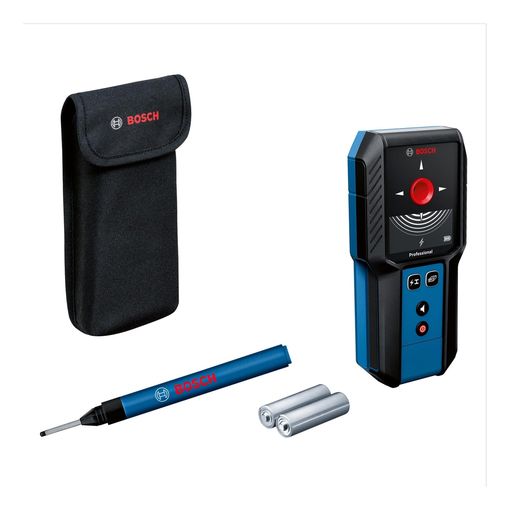
Bosch built its professional reputation on tools tradespeople reach for daily. The GMS 120-27 carries that over into a wall scanner that switches between wood, magnetic metal, non-magnetic metal and live-wire modes with a single button. Reviewers who use it professionally describe it paying for itself the first time it flags a hidden cable. Its colour-coded ring gives a fast go or no-go signal rather than a number you have to interpret. One buyer, reviewing after weeks of regular use, called it "reliable and very accurate." That lines up with the broader pattern in its reviews, once people take the time to read the instructions first. It isn't perfect on every surface, though. Several owners note it struggles on walls finished with certain paints, resins or thick wallpaper, so it's a tool for confidence rather than certainty.
The Reliable All-Rounder's Full Details
The GMS 120-27 detects non-magnetic metal to 120mm, magnetic metal to 100mm, live wires to 50mm and wood to 30mm. It carries an IP54 rating for dust and splash resistance in a shock-absorbing rubber housing.1 It runs on two included AA batteries, or an optional rechargeable Bosch Li-Ion cell, and ships with a marker pen and carrying pouch. Bosch backs its measuring tools with a standard warranty that extends further when the tool is registered, in line with the rest of its professional range.
Franklin Sensors ProSensor 710+
Best for Finding Multiple Studs at Once
based on 10351 Amazon reviews (4.2★), adjusted for performance, build and value
Why the Multi-Sensor Pick Earns Its Spot
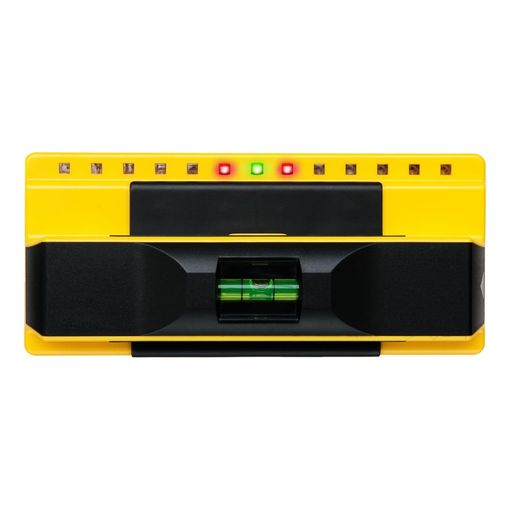
Instead of one sensor you sweep back and forth, the ProSensor 710+ packs 13 sensors into a wide scan bed. That lights up the entire width of a stud, and any neighbouring double studs, the moment you hold it against the wall. There's no calibration step, and no need to start from a "clear" section of wall first. You can begin scanning directly over a stud and still get a correct reading, which is the feature carpenters and joiners praise most often in its reviews. It has genuine longevity concerns, though. One buyer used it once, put it away, and came back two years later to find it wouldn't power on at all, past its warranty window by then. That's a useful counterweight to the otherwise glowing feedback. Buy fresh batteries for it, and don't expect it to sit unused indefinitely and still work first time.
Where the Multi-Sensor Pick Falls Short
The 710+ has no live-wire or AC detection mode at all, only wood and metal stud sensing. Pair it with a separate voltage tester on any wall where cables are a real possibility. Franklin Sensors' own guidance is that its stud finders "work best through a single layer of sheetrock/drywall." Many customers report success on lath and plaster. But the company is explicit that it cannot guarantee that performance, since plaster thickness varies so much from wall to wall.2 It includes a built-in bubble level and integrated ruler, and needs two standard AA batteries that are not compatible with rechargeables.
Franklin Sensors ProSensor M210
Best Multi-Sensor Stud Finder with Live-Wire Warning
based on 6258 Amazon reviews (4.2★), adjusted for performance, build and value
What Sets This One Apart From Its Sibling
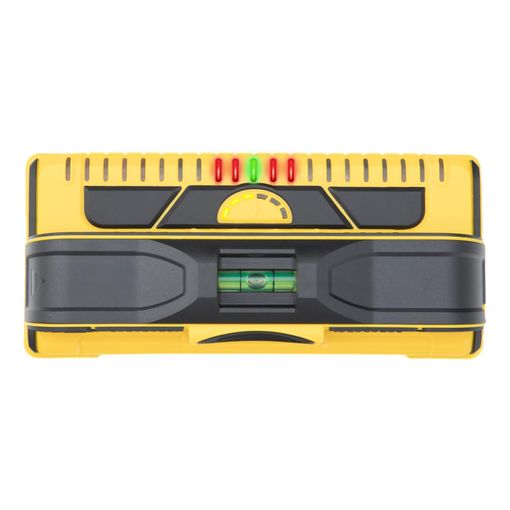
The M210 takes the same 13-sensor array that makes the 710+ so good at finding stud edges. It then adds a live-wire warning, a pencil caddy and compatibility with rechargeable batteries. A professional TV installer reviewing it called it "by far the best stud finder I've owned," praising how quickly it shows the full width of a stud without needing to calibrate first. For anyone who wants Franklin's multi-sensor accuracy without buying a separate wire detector, it's the more complete of the two ProSensor models in this lineup.
The Honest Limits of Its Live-Wire Mode
This is also where several owners were let down. Multiple reviewers describe the AC detection as inconsistent. One says it lit up next to a socket and then stopped detecting anything once a hand touched the wall nearby. Another dismissed it outright as "not worth paying extra for." Take the wire warning as a rough early signal, never a substitute for a dedicated voltage tester before drilling. None of its verified-purchase reviews we found established a clear multi-month or multi-year ownership timeframe. Its longer-term durability is harder to judge than the 710+'s as a result.
CH Hanson 03040 Stud 4 Sure Magnetic Stud Finder
Best Magnetic Stud Finder
based on 29815 Amazon reviews (4.6★), adjusted for performance, build and value
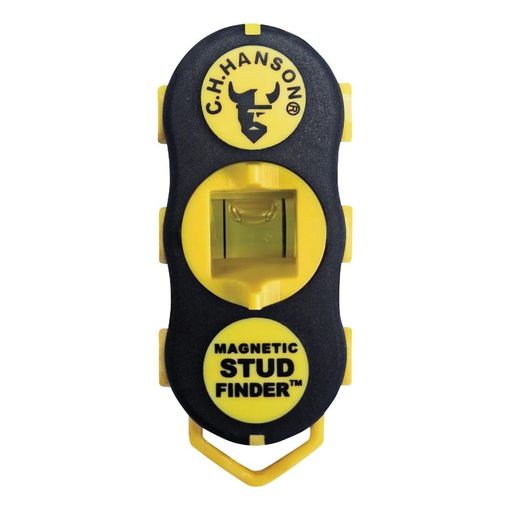
Why It's the Magnetic Benchmark
With nearly 30,000 ratings and a 4.6-star average, the CH Hanson 03040 is the most reviewed product in this entire roundup. The reason is simple. It works, it costs very little, and there's nothing electronic inside it to eventually fail. Two rare-earth magnets grip onto the screws or nails holding your plasterboard to its frame. A built-in level then helps you mark a straight vertical line once you've found one. A tradesperson who fits wall cabinets for a living described colleagues switching to this one after giving up on battery-powered detectors. Several reviewers also note it still gripping lath-and-plaster fixings that other magnetic finders can't reach through thicker old plaster. We couldn't find a review establishing a specific multi-year ownership timeframe for this one. Given the complete absence of electronics or batteries, though, that's arguably less of a concern here than for scanner-style units.
What a Magnet Can't Do
The obvious tradeoff is that it only finds fasteners, not timber directly. A stud without a nail or screw nearby, or one built with an adhesive-only fixing, won't register at all. It also can't tell you anything about metal pipework, cables, or non-ferrous studs. If your walls are metal-framed rather than timber, look further down this list instead.
The StudBuddy Magnetic Stud Finder
Best Compact Pocket Stud Finder
based on 15633 Amazon reviews (4.4★), adjusted for performance, build and value

The Case for Going This Simple
The StudBuddy strips a magnetic stud finder down to its smallest possible form. It's a single moulded piece of plastic around two magnets, with no level, no batteries and nothing to break. Reviewers who mount downlights, shelves and TV brackets like that it sticks firmly to a wall once it finds a fastener, freeing up both hands to mark the spot. Over 15,000 buyers have rated it, most describing exactly the kind of unglamorous reliability you want from a tool this cheap. We didn't find a verified-purchase review establishing an explicit long-term ownership period. That's common for a tool this simple and this cheap, where owners tend to mention that it worked rather than report back after months of use.
Small Compromises for a Small Price
A few owners note the plastic housing has no soft-touch backing. Dragging it across painted walls can leave faint marks over time. It also only works where a stud has a nail or screw at a depth its magnets can reach, and it comes with no level. You'll want a separate level or laser to mark a plumb line once you've found your fastener.
Kreg KMM1000LZ Magnetic Stud Finder with Laser-Mark
Best Magnetic Stud Finder with Laser Marking
based on 1114 Amazon reviews (4.5★), adjusted for performance, build and value
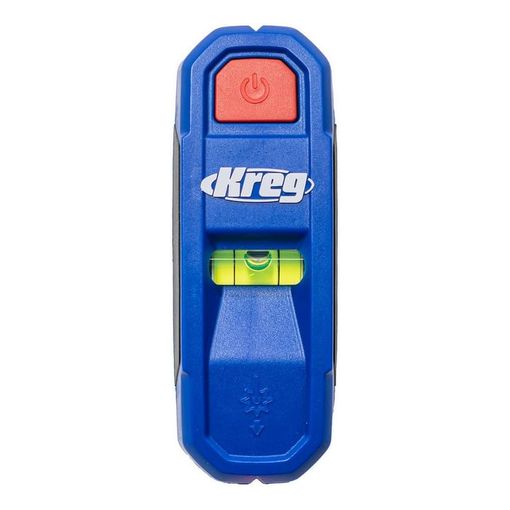
The Convenience That Justifies the Upgrade
Kreg is a brand better known for pocket-hole jigs and cabinet-building tools than detectors, and it applies the same problem-solving approach here. It keeps the reliable magnet-based detection of the CH Hanson and StudBuddy, then adds a laser that projects the stud's location up or down the wall at the push of a button. That turns "I found a fastener here" into "here's exactly where to mark the whole run," which is genuinely handy when hanging a cabinet rail or a long picture shelf. Owners consistently mention the laser stays visible even in a reasonably bright room. A 4.5-star average across over a thousand ratings backs up the general enthusiasm. None of its verified-purchase reviews we found reported back after a meaningful stretch of ownership. Its long-term reliability rests more on Kreg's broader reputation than on this specific product's track record, then.
What the Laser Adds and Doesn't
The laser is a low-power diode of the kind classified internationally as a Class 2 laser. It's bright enough to see clearly indoors, but not intense enough to cause harm from a brief, incidental glance, since the natural blink reflex limits exposure before any damage occurs.3 That said, never stare directly into any laser marker deliberately. Functionally, it's still a magnetic detector underneath. It inherits the same fastener-only limitation as the CH Hanson and StudBuddy above.
Zircon MultiScanner A250c
Best for Plaster and Lath-and-Plaster Walls
based on 523 Amazon reviews (4.2★), adjusted for performance, build and value
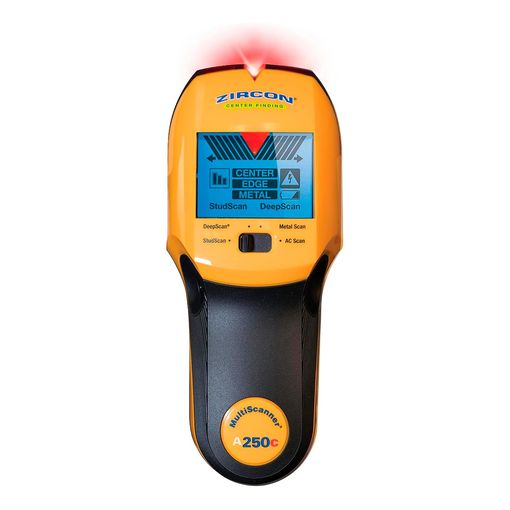
Why This Is the One for Older Walls
Lath-and-plaster walls are the case most stud finders quietly fail on. Plaster is far thicker and less consistent than a sheet of drywall. A shallow scan mode built for modern stud walls often can't see far enough to find anything real, and can just as easily return a confident false positive instead. The A250c's Metal Scan mode is built around this exact problem. Rather than sensing the stud's density directly, it locates the pattern of screw or nail heads holding the lath in place. That's the same signal a magnetic finder relies on, but read electronically and displayed with centre, edge and depth information on its colour LCD.4 A four-mode selector switches between StudScan, DeepScan, Metal Scan and AC Scan, and the display itself changes colour depending on which mode is active.
Where It's a Mixed Bag
Reviews on this unit are more divided than most others here. One owner calls it "mediocre at best," and another describes it as overly sensitive to false electrical readings, so it isn't a unanimous favourite even among electronic scanners. Its smaller review base, in the low hundreds rather than thousands, also means there's less long-term data to judge it against. None of the reviews we found established a specific multi-month ownership period. It runs on a single 9V battery, which is not included.
Walabot DIY 2
Best Visual Imaging Stud Finder
based on 2509 Amazon reviews (4.0★), adjusted for performance, build and value
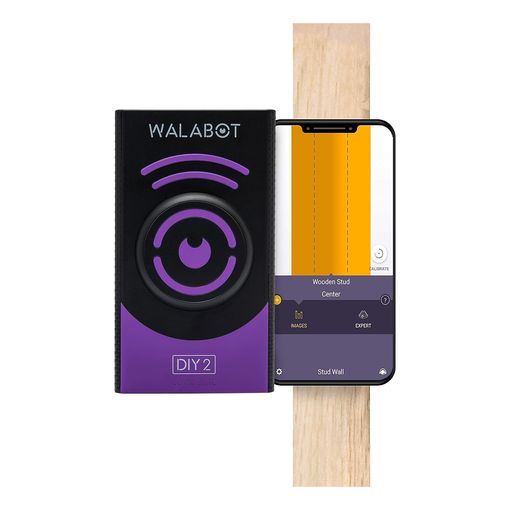
A Genuinely Different Way of Seeing Into a Wall
Every other product on this list gives you a beep, a light, or a number. The Walabot DIY 2 pairs with a free phone app over Wi-Fi instead. It shows a live, moving image of what's actually inside the wall as you sweep it across the surface, tracking wood and metal studs, pipes and wires up to roughly 10cm deep.5 One reviewer, a tradesperson, called it "worth its weight in gold" on jobs cutting into ceilings and walls all day. A homeowner who'd struggled to pin down a stud centre with a conventional scanner had a visual answer within seconds of trying this instead. It's also the only tool here that can flag movement inside a wall cavity, useful for spotting pest activity as well as building materials.
The Real Costs of That Capability
This is comfortably the most expensive product in the roundup, priced well above every other option here. That premium buys genuine capability rather than gimmick features. It does have real quirks, though. It needs its own battery kept charged, since letting it run flat entirely can cause charging problems, and it needs a phone within range to work. A few owners also found the graphics could be misleading on pipes and cables specifically. None of its verified-purchase reviews we found reported back after months or years of ownership. Weigh its price against genuinely needing what only this format offers, rather than assuming it's simply the most accurate option by default.
HANMATEK SF1 4-in-1 Stud Finder
Best Budget Stud Finder
based on 8332 Amazon reviews (4.1★), adjusted for performance, build and value
Solid Value for Occasional DIY Use
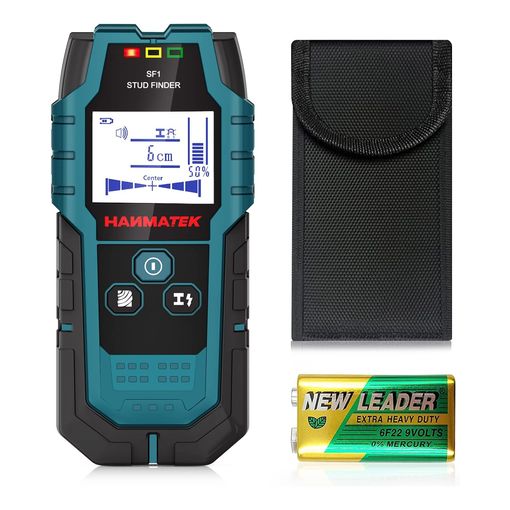
For anyone who'll use a stud finder a handful of times a year rather than daily, the HANMATEK SF1 gets most of the fundamentals right for the most affordable price in this lineup. Its four modes cover ferrous metal, non-magnetic metal, live AC wires and a deeper scan setting for extra wall layers. All of it shows on a backlit LCD that displays depth in centimetres, rather than just a light or a beep. One buyer who'd previously used a pricier Bosch scanner said this one was "much better" at finding joists, cables and pipes with a visible distance readout. Over 8,000 ratings suggest that's a common enough experience.
Why It's Not the Top Pick
Reviews for the SF1 are more mixed than for the pricier options here. Several owners report erratic AC-detection behaviour, including alarms triggering next to solid concrete or failing to register a known live socket. As with every electronic scanner on this list, its wire warning should never be your only safety check before drilling. Build quality is functional rather than rugged. We also found no verified-purchase review establishing a clear multi-month or multi-year ownership period for this specific model.
Best Stud Finder FAQ
What's the real difference between a magnetic and an electronic stud finder? A magnetic stud finder locates the metal fasteners, nails or screws, holding your wall board to its frame. It uses nothing but a strong magnet, so it never needs batteries and never gives a false reading from wall density alone. An electronic stud finder senses changes in material density as you sweep it across the wall instead. It can find the stud itself even where there's no fastener nearby, but it's more sensitive to uneven walls, thick paint and old plaster.
Why do some stud finders struggle on plaster and lath-and-plaster walls specifically? Old lath-and-plaster construction is thicker and far less consistent than a sheet of modern drywall. Manufacturers are upfront that this affects results. Franklin Sensors states plainly that many of its stud finders work on lath and plaster. But it also says it "cannot guarantee their performance," since plaster thickness varies so much from wall to wall.2 A scanner's shallow default mode is built around single-layer drywall. It may simply not reach far enough to register anything reliable on these older wall types. That's why a dedicated deep-scan mode matters more here than the spec sheet suggests.
Can a stud finder's live-wire detection mode replace a proper voltage tester? No. Live-wire or AC-scan modes are a helpful early warning, not a certified safety device. Reviews across several products in this roundup describe inconsistent readings around known live sockets. Treat any live-wire alert as a reason to stop and investigate further with a dedicated, calibrated voltage tester before drilling. Never treat it as confirmation that a wall is safe on its own.
What does "deep scan" actually mean on an electronic stud finder? It's a higher-sensitivity mode intended for walls with extra layers, thicker plaster, or tile. It typically roughly doubles the standard scan depth. On the Zircon MultiScanner A250c, for example, standard StudScan reaches about 19mm, while DeepScan mode extends that to around 38mm.4 The tradeoff is that deep-scan modes are also more prone to false positives. Slower, more deliberate sweeps tend to give more trustworthy results than quick passes.
Are visual imaging stud finders like the Walabot more accurate than traditional scanners? They solve a different problem rather than simply being "more accurate." A visual scanner shows you a picture of studs, pipes and wires together, up to around 10cm deep. That helps you understand a wall's whole layout rather than just confirming a single point.5 Traditional electronic and magnetic finders remain perfectly capable for a simple single-stud job. The visual format earns its higher price on more complex walls, where knowing the full picture actually changes your plan.
Is a laser marker on a stud finder like the Kreg safe to use indoors? Yes, when used as intended. Consumer-grade laser markers on tools like this are typically low-power laser diodes classified internationally as Class 2. That means the natural blink reflex is fast enough to prevent eye damage from brief, accidental exposure.3 As with any laser product, avoid pointing it directly at anyone's eyes, and never stare into the beam deliberately.
Do stud finders work on metal-framed partition walls, not just timber? Electronic scanners with a dedicated metal mode work on metal-framed walls, and so do magnetic finders in general. Both are detecting the metal track or stud itself, or the screws fixing board to it, rather than timber specifically. If you know or suspect your walls use metal studwork, favour a product with an explicit metal-detection mode over a wood-only model.
How long should I expect a stud finder to last? It varies more by type than by price. Battery-free magnetic finders have effectively nothing to wear out, and several reviewers describe using the same one for years without issue. Battery-powered electronic units are more mixed. One buyer of the Franklin Sensors ProSensor 710+ found theirs wouldn't power on again after two years of storage between uses. That's a reminder that infrequent use and stale batteries can matter as much as the unit's inherent build quality.
Should I trust a stud finder's first reading on an important job? Not blindly. Reviewers across nearly every product in this roundup mention getting their most reliable results by rescanning a section two or three times, checking from both directions, and drilling a small pilot hole to confirm before committing to a larger fixing. This matters most for heavy TV mounts, wall cabinets and anything load-bearing, where a missed stud has real consequences.
What else is worth buying alongside a stud finder? A dedicated non-contact voltage tester is the obvious pairing. None of the live-wire modes here should be your only check before drilling. If you're marking out level lines for shelves or cabinet runs once you've found your studs, our best laser level roundup covers the tools for that next step.
The Best Stud Finder for You
For most people, the Bosch Professional GMS 120-27 is the safest all-round buy. It's one tool that covers wood, metal and live wires, backed by a trusted brand. If you're chasing raw accuracy on a straightforward timber-framed wall, either Franklin Sensors ProSensor model will outperform it for less money. Anyone dealing with an older lath-and-plaster property should look first at the Zircon MultiScanner A250c. Tight on budget, or just want something that will never let a flat battery ruin a Saturday project? The magnetic options from CH Hanson, StudBuddy and Kreg all cover that ground reliably. And the Walabot DIY 2 is there for anyone who wants to see the whole picture before drilling a single hole.