

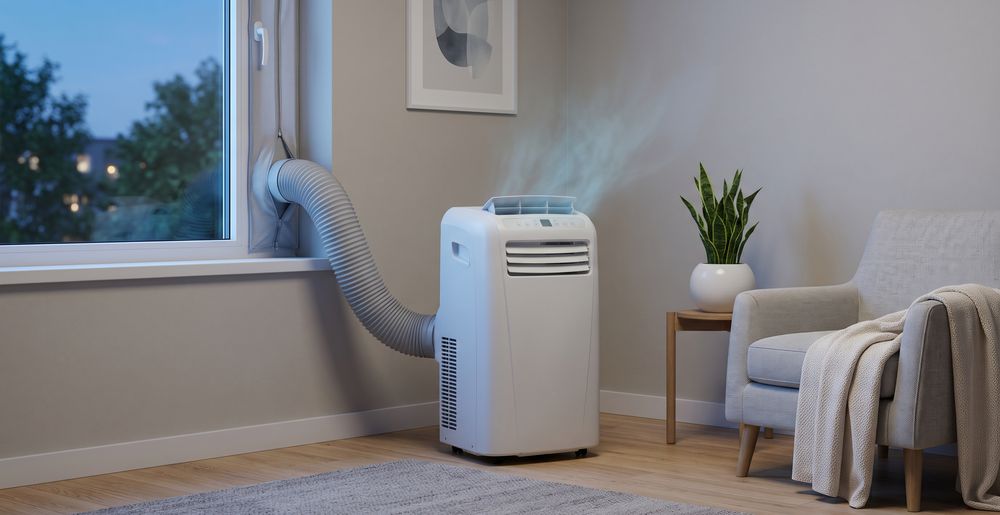
Best Portable Air Conditioner for Honest Cooling Power

About the author...
Dave has been taking gadgets apart since he was old enough to be told not to. Every pick here is checked against the manufacturer's own documentation rather than the retail listing, and each star rating starts from a product's real Amazon customer score before being adjusted for performance, build quality, features and value. Read more about how ratings are calculated.
Table of contents
- Key Takeaways (TL;DR)
- How We Choose
- Quick Comparison
- BLU-09 9,000 BTU Portable Air Conditioner
- AuraHome Portable Air Conditioner 9000 BTU
- Pro Breeze 4-in-1 Portable Air Conditioner 9000 BTU
- Pro Breeze 12000 BTU Portable Air Conditioner
- DREO 10000 BTU Portable Air Conditioner AC515S
- DREO 12000 BTU Portable Air Conditioner AC516S
- BLU12 12,000BTU Portable Air Conditioner
- Best Portable Air Conditioner FAQ
- The Best Portable Air Conditioner for You
The best portable air conditioner right now is the BLU-09 9,000 BTU, thanks to a cooling output that actually matches its marketing and the most consistently positive, longest-proven verified-purchase history in this lineup. See the comparison below for how six other well-reviewed alternatives stack up depending on your room size, budget, and how much you want the unit to do beyond cooling.
A portable air conditioner is a self-contained cooling unit on wheels. It vents hot air out through a hose, usually run out of a cracked-open window. It suits anyone who can't or doesn't want a fixed split system: renters, flat-dwellers, anyone cooling one room rather than a whole home, or anyone who wants a unit they can move between rooms or pack away at the end of the season. It isn't as efficient as a wall-mounted split system, since it pulls room air back through itself to cool its own condenser. But it needs no outdoor unit, no drilling, and no installer visit.
Not every portable AC in this category is honest about what it actually delivers. The BTU figure on the box is the single most misleading number in this whole product category. Buyers who compare two units purely on that number can badly misjudge which one will actually cool their room. The lineup below explains that distortion rather than repeating it, and weighs real room coverage, noise, and maintenance burden alongside the headline spec.
Key Takeaways (TL;DR)
- The advertised BTU figure is often an older, more generous rating than the stricter SACC standard — don't assume two units with the same printed BTU number cool the same amount of room.
- Almost every well-reviewed portable AC on the market is single-hose, not dual-hose. True dual-hose consumer units are rare outside specialist or commercial channels.
- "Drainage-free" or "self-evaporating" designs cut daily maintenance but still need manual draining in very humid conditions or heavy dehumidifier use.
- A short factory exhaust hose (often around 1.5m) is the most common real complaint across this entire category, so check your window's distance from a socket before you buy.
- Expect genuine compressor noise in the 46-54dB range: these are not whisper-quiet appliances, more like a running fridge or a powerful desk fan on high.
- Match capacity to room size, not the biggest BTU number on the shelf — an oversized unit in a small room cycles on and off more, which is noisier, not more effective.
- A well-built unit should last several seasons with basic filter care; budget for an annual clean and expect the exhaust hose and window kit to be the first parts that wear out.
How We Choose
We weigh four things for every portable air conditioner here. How effectively it actually cools a room, relative to its advertised capacity. How solid the build and window-venting kit feel in daily use. How useful its extra features genuinely are, rather than how long the spec sheet reads. And how it stacks up on price against the other picks in this exact lineup.
We don't run our own lab tests on these. No calibrated test chamber, no thermal-imaging rig, no controlled room at a fixed outdoor temperature. What we do instead: we read the verified-purchase reviews in full, not just the star average. We weight the ones written weeks or months after purchase over launch-week first impressions, since that's where hose wear, window-kit wear, and compressor reliability actually show up. We also check marketed cooling claims against how the BTU rating system for this category really works, because the headline number on a listing is often more flattering than what a buyer actually gets in their own room. Where a product genuinely lacks a long ownership track record, we say so below rather than papering over it.
Quick Comparison
Each product's overall rating starts from its real Amazon customer rating, then gets adjusted (up to ±0.5) for real-world performance, build quality, features, and value. Click a product name to jump straight to its full review below.
| Product | Best For | Type | Key Detail | Cooling Power |
|---|---|---|---|---|
|
BLU-09 9,000 BTU Portable Air Conditioner 4.9 |
Best Overall Portable Air Conditioner | Single-hose portable AC | 9,000 BTU (8,870 BTU actual output) | R290 refrigerant, self-evaporating, 2.5kW cooling |
|
AuraHome Portable Air Conditioner 9000 BTU 4.2 |
Best Budget Pick | Single-hose portable AC | 9,000 BTU, 22.5kg | GMCC compressor, R290 refrigerant |
|
Pro Breeze 4-in-1 Portable Air Conditioner 9000 BTU 4.1 |
Best Known-Brand Pick | Single-hose portable AC | 9,000 BTU, WiFi app control | WiFi/Alexa/Google Home, R290 refrigerant |
|
Pro Breeze 12000 BTU Portable Air Conditioner 4.2 |
Best for Larger Rooms | Single-hose portable AC | 12,000 BTU, 115° oscillation | WiFi app control, 115° auto-oscillating louvres |
|
DREO 10000 BTU Portable Air Conditioner AC515S 4.6 |
Best Compact Smart Pick for Bedrooms | Single-hose portable AC | 10,000 BTU, drainage-free | Drainage-free to 90% humidity, app/voice control |
|
DREO 12000 BTU Portable Air Conditioner AC516S 4.8 |
Best Smart, Drainage-Free Pick for Bigger Rooms | Single-hose portable AC | 12,000 BTU, drainage-free | Drainage-free to 90% humidity, app/voice control |
|
BLU12 12,000BTU Portable Air Conditioner 4.7 |
Best All-Season Pick | Single-hose portable AC with heating | 12,000 BTU, heating + cooling | R290 refrigerant, heat pump mode, self-evaporating |
BLU-09 9,000 BTU Portable Air Conditioner
Best Overall Portable Air Conditioner
based on 562 Amazon reviews (4.6★), adjusted for performance, build and value
What We Love About the Overall Pick
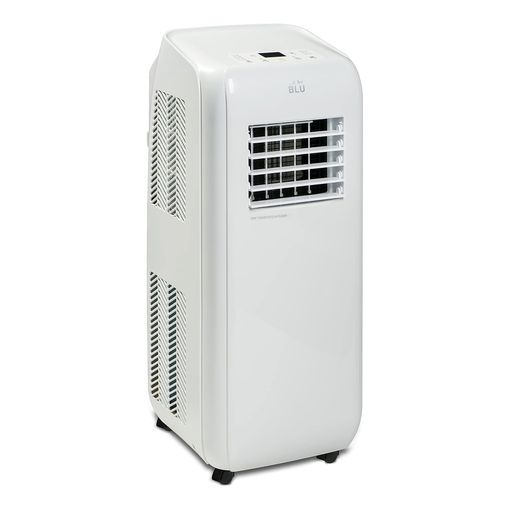
The BLU-09 earns its spot the old-fashioned way: it does what it says on the box. Its own listing states a real cooling output of 8,870 BTU against a marketed 9,000 BTU. That's an honest, close-to-accurate figure rather than an inflated one. With 562 verified reviews and one of the highest ratings here, it also has one of the longest-proven owner histories in this lineup. It's cooling-only, with no heating mode, but that focus shows. Reviewers consistently describe it bringing a room down several degrees within an hour. One owner, "Warg," bought theirs in 2022 and came back in 2026 specifically to buy a second one, to avoid lugging the first between floors. After four straight summers of daily use, they said it had "no issues whatsoever." That's a rare, genuinely multi-year endorsement in a category where most reviews are written in the first week of ownership.
Overall Pick: All The Details
The BLU-09 is a single-hose, self-evaporating unit. It recycles roughly half its condensed water to cool its own coils, then vents the rest out with the hot exhaust air. That means it rarely needs manual draining in normal cooling use. It uses R290 refrigerant, ships with a 1.5m exhaust hose and a window sheet for side-hinged casement windows, and weighs around 26kg on castors. The most consistent complaint in its review history is that the hose and window-seal kit are fiddly to fit, and a little short for some window layouts. Several owners bought a cheap extension hose rather than return the unit over it. It's sold with a 30-day return window through its Amazon seller, with no fixed-term manufacturer warranty beyond standard consumer protections, so keep your receipt.
AuraHome Portable Air Conditioner 9000 BTU
Best Budget Pick
based on 71 Amazon reviews (4.1★), adjusted for performance, build and value
Why This Is the Value Pick
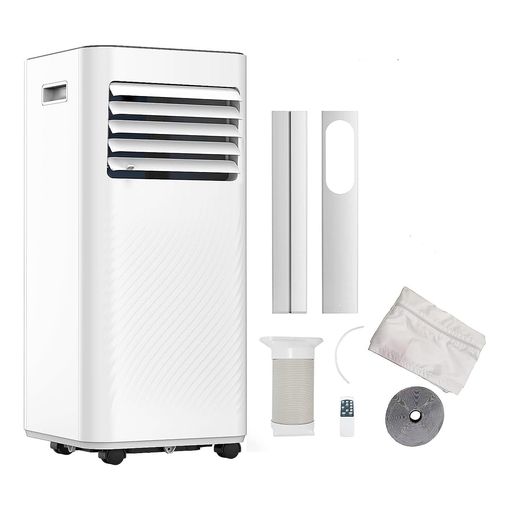
The AuraHome sits at the most accessible price point in this lineup, but it still delivers the same 9,000 BTU class. It also uses a named compressor brand (GMCC) rather than an unbranded part, a small but real signal that it isn't a pure race-to-the-bottom build. Reviewers consistently describe fast cooling in a single bedroom or small flat. One buyer cooled a room from over 30°C to a sleep-friendly temperature overnight. It gives up some polish for that price: there's no WiFi app, no oscillation, and just two fan speeds. One verified buyer, "Pootle_around," bought it in February 2024 ahead of summer. They reported back in June that it had sat in storage for months before its first real test, then cooled their bedroom "in under 10 mins" the moment it was finally needed. That's a useful signal that it holds up fine between seasons, even if it doesn't establish years of daily running time.
Value Pick: All The Details
The AuraHome is rated 9,000 BTU and covers rooms up to roughly 20 square metres by its own listing. It uses R290 refrigerant, with a stated noise level up to 54dB. It includes a sliding-window-compatible vent kit, a drain pipe, a water-full indicator, and a child lock. At 22.5kg, it's among the lighter units here. One verified review flagged a month-long shipping delay, with inaccurate tracking information from the seller. That's worth knowing if you're buying close to a heatwave rather than ahead of one. This isn't a unit to order at the last minute and expect next-day delivery.
Pro Breeze 4-in-1 Portable Air Conditioner 9000 BTU
Best Known-Brand Pick
based on 807 Amazon reviews (4.0★), adjusted for performance, build and value
Why the Known Brand Earns Its Spot
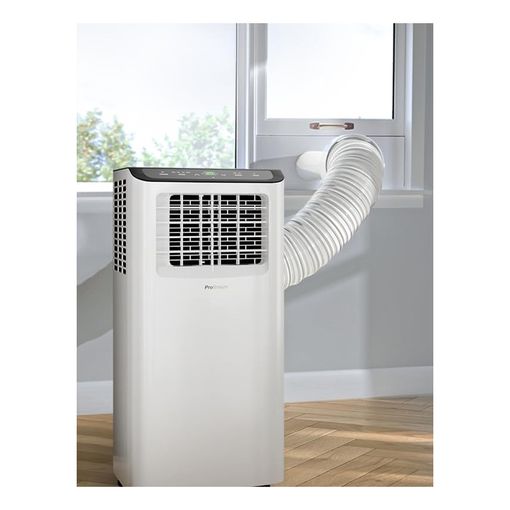
Pro Breeze is a dedicated cooling brand with its own direct site, a genuine WiFi app, and Alexa and Google Home integration. With 807 verified reviews, it's also the single most-reviewed portable AC in this entire lineup. That review volume means its flaws are well documented rather than hidden. Noise is a recurring theme, and at least one buyer reported the cooling function failing outright after roughly two months of use. Pro Breeze's own customer service did resolve a separate WiFi fault for another reviewer, with a full replacement. One owner, "S.K.," put it plainly after extended use: "I have been using this for more than a year to cool my nearly 4 by 4 metre bedroom and it works so well." That's a genuinely reassuring signal, given how much shorter most reviews in this category tend to be.
Known-Brand Pick: All The Details
This unit is rated 9,000 BTU with a Class A energy rating. It covers medium-to-large rooms with four modes: cooling, dehumidifying, fan-only, and sleep. It ships with two window venting kits, for sliding or hinged frames. It uses R290 refrigerant, runs at a stated 54dB, and weighs around 25kg. Several reviewers note the asking price moves around noticeably with demand, spiking during heatwaves. Buy ahead of a hot spell rather than during one if price matters to you. Pro Breeze's own support team is repeatedly praised by name in reviews for handling faults quickly, including shipping replacement parts the next day.
Pro Breeze 12000 BTU Portable Air Conditioner
Best for Larger Rooms
based on 117 Amazon reviews (4.1★), adjusted for performance, build and value
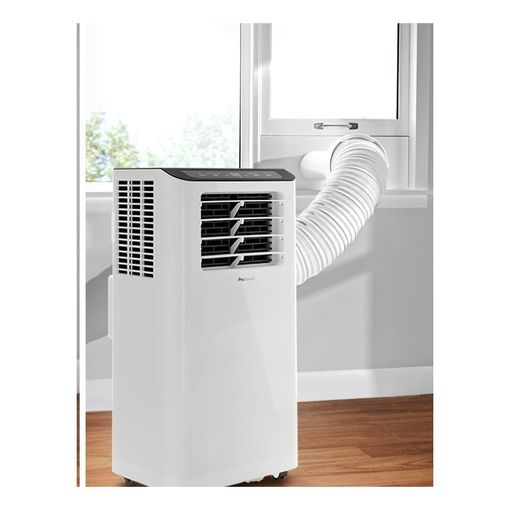
The Large-Room Step-Up, Explained
Step up from the 9,000 BTU model and you get a wider 115° auto-oscillating louvre spread. That means genuinely more cooling headroom for an open-plan living room, rather than just a bedroom. One owner reported it cooling their entire downstairs. Another, more cautiously, found it brought a medium bedroom from 28°C to 21°C over a couple of hours, rather than instantly. That's a more realistic expectation to set than the box's "16°C" claim implies. We couldn't find a verified-purchase review establishing ownership beyond the first few weeks for this exact 12,000 BTU listing. One reviewer wrote candidly, a month in, "I can't speak on the longevity yet." That's an honest gap worth knowing, rather than a reason to avoid it outright, since the shared design and parts track closely with the well-reviewed 9,000 BTU model above.
Large-Room Pick: All The Details
This unit is rated 12,000 BTU, with the same four-mode, Class A, R290-refrigerant design as the 9,000 BTU model. It adds 115° vertical oscillation for wider coverage and ships with a window kit for both sliding and hinged frames. Several reviewers flag the condensate collection tray as awkward to empty without spilling. The included window seal also fits only a subset of casement and sash window styles. More than one owner built a custom wood-and-rubber seal instead. As with the smaller model, Pro Breeze's own customer support is consistently praised for fast, no-quibble handling of faults and returns.
DREO 10000 BTU Portable Air Conditioner AC515S
Best Compact Smart Pick for Bedrooms
based on 291 Amazon reviews (4.3★), adjusted for performance, build and value
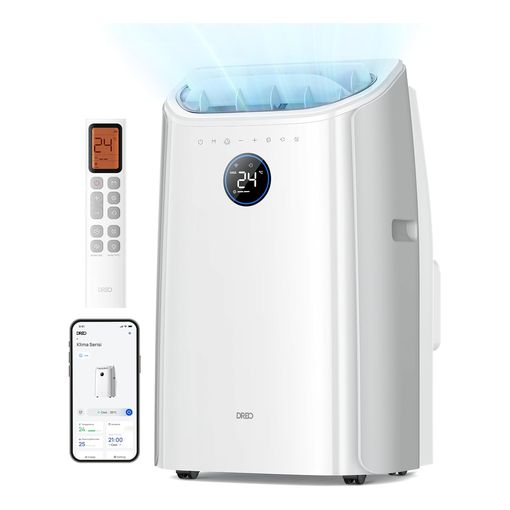
What Makes the Compact Smart Pick Stand Out
DREO built its name on smart fans and heaters before it moved into air conditioning, and that app-and-sensor background carries over clearly here. Its "drainage-free" system is designed to evaporate collected condensate automatically, in humidity up to 90%. Multiple owners confirm going weeks without needing to empty a tank, a genuine convenience most cheaper units can't match. One reviewer, "TF," reported that after two weeks of continuous running they "didn't have to drain any water yet." That's a short but real early signal, given this is a newer release with limited long-term history on Amazon so far. Another detailed reviewer had expected an R32 unit, based on other listings, and found it actually shipped with R290 refrigerant instead. That's a labelling mismatch worth knowing about, even though they said it cooled effectively regardless.
Compact Smart Pick: All The Details
This unit is rated 10,000 BTU (2.9kW), with a 3.2L/H dehumidification rate. It's controllable via touchpad, a magnetic-backed remote, the DREO app, or Alexa and Google Assistant voice commands, and includes a graphed usage history in the app. DREO states a 46dB noise level. Independent owner measurements using phone decibel apps commonly land closer to 50dB in real rooms, though, so treat the lower figure as a best case rather than what you'll hear at your bedside. It uses R290 refrigerant and ships with a universal window kit. Buyers with casement (side-hinged) windows do report needing to improvise beyond the supplied sliding-window fittings.
DREO 12000 BTU Portable Air Conditioner AC516S
Best Smart, Drainage-Free Pick for Bigger Rooms
based on 276 Amazon reviews (4.5★), adjusted for performance, build and value
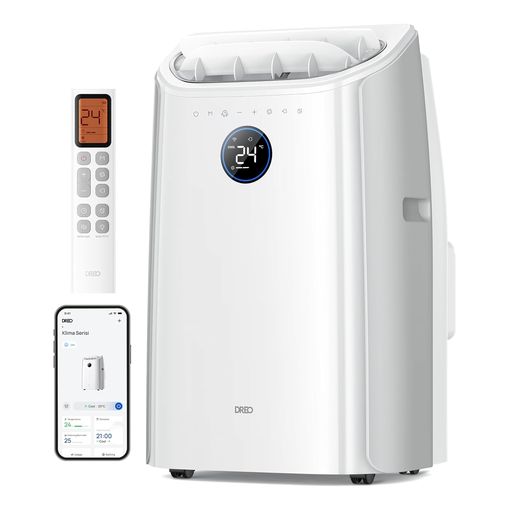
Why This Takes the Top Smart Spot
This is the strongest all-round smart pick in the lineup, and the reviews back that up across several countries, not just one. Owners consistently praise genuinely low day-to-day maintenance. One buyer who deliberately tracks this said it needed no draining at all, through weeks of near-daily use across a run of summer heatwaves. Another reported it keeping a 32m² open-plan living room comfortable from a 32°C starting point. Like its smaller sibling, this is a 2026 release, so no review we found establishes ownership beyond a single summer season. The best signal we have is one detailed buyer, "Bishie Bishie," who described using it continuously through three separate named heatwaves across June and July without a fault. That's a reasonable stand-in for sustained, heavy-use reliability, even if it falls short of a multi-year track record.
Smart, Drainage-Free Pick: All The Details
This unit is rated 12,000 BTU (3.5kW), with a 3.6L/H dehumidification rate. Mechanically, it's the same drainage-free platform as the AC515S above, scaled up, with the same touchpad, remote, app, and voice control options, and a stated 46dB noise figure. Several buyers measure it closer to 50-55dB in practice, though. It uses R290 refrigerant and includes a universal window seal kit. The most consistent complaint across reviews is the exhaust pipe running hot enough to radiate noticeable heat back into the room, unless it's wrapped in an insulating sleeve. Several owners recommend buying one separately, since it isn't included.
BLU12 12,000BTU Portable Air Conditioner
Best All-Season Pick
based on 226 Amazon reviews (4.4★), adjusted for performance, build and value
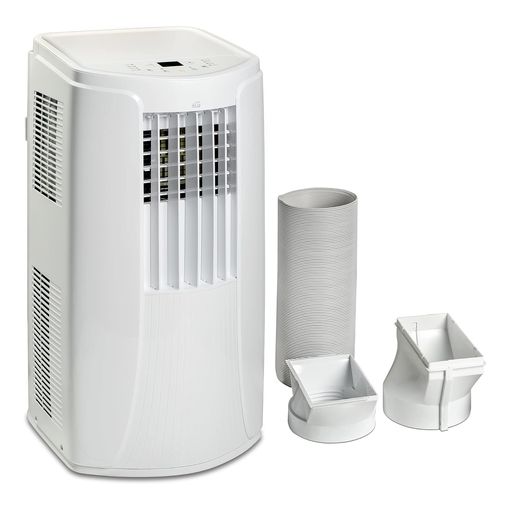
The Case for Going All-Season
Every other unit in this lineup is cooling-only. The BLU12 adds a genuine heat pump mode on top of the same self-evaporating, R290-refrigerant platform as the BLU-09. That means one appliance can justify its footprint year-round, instead of sitting in a cupboard for nine months. Reviewers use it for both jobs: cooling a bedroom in summer, and taking the chill off a home office or conservatory in shoulder seasons. One verified owner, "SGS," reviewed it twice: first after purchase, then again "after using the Blu as a cooler for more than a year." The second time, they reported a real design flaw with the continuous-drainage plumbing, which caused the unit to throw a fault code until they worked out an undocumented fix. That's exactly the kind of honest, lived-in signal a star rating alone won't give you, and it's reported here rather than smoothed over.
All-Season Pick: All The Details
The BLU12 is rated 12,000 BTU for cooling and the same figure for heating, with A and A+ energy classes on cooling and heating respectively. It uses R290 refrigerant, ships with a 1.5m hose and a casement-window seal kit, and runs at a stated 49-53dB sound pressure level. It has no oscillation function by design, relying instead on even distribution through its front grille. Several long-term reviewers praise the seller's customer service for shipping replacement parts and spare hose couplings quickly when asked. That matters more for an appliance you'll realistically keep for years, rather than one season.
Best Portable Air Conditioner FAQ
Should I get a single-hose or dual-hose portable air conditioner? Single-hose. Every well-reviewed unit in this roundup is single-hose, and so is most of what's genuinely well-supported and widely stocked. A single-hose unit draws the air it exhausts from inside your room. That creates slight negative pressure, which pulls a small amount of warm air back in from outside through gaps elsewhere in the room. It's a real but modest efficiency loss. A dual-hose design draws its exhaust air from outside instead, avoiding that loss, and is genuinely more efficient in principle. In practice, true dual-hose consumer units are a much smaller niche in mainstream retail. They're more commonly found through specialist or commercial suppliers than on a typical general retailer's shelf. Budget for single-hose as the realistic default, rather than holding out for a dual-hose model that may not be readily available wherever you're buying.
Why does the BTU number on the box not match what I read about elsewhere? Because two different rating systems exist for this product category, and manufacturers aren't always clear about which one they're quoting. The older ASHRAE-style rating was based on ideal lab conditions. A newer standard, Seasonally Adjusted Cooling Capacity (SACC), tests closer to real-world conditions. It also accounts for the fact that a portable AC draws some of its own exhaust air back from the room it's cooling. The SACC figure for a given unit is reliably lower than its ASHRAE figure for the same hardware. One manufacturer's own support documentation gives an example: a unit rated 14,000 BTU under the old ASHRAE method is the same hardware as a 10,000 BTU SACC-rated unit1. Treat a bare BTU number on a listing with some caution. Don't assume two units with the same printed figure deliver the same real-world cooling.
How many BTU do I actually need for my room? Treat any manufacturer's room-size claim as optimistic, and size up if you're unsure. As a rough starting point: a small bedroom up to around 15m² suits a 7,000-9,000 BTU unit. A larger bedroom or home office up to around 20-25m² suits 9,000-12,000 BTU. An open-plan living space, a room with a lot of south-facing glass, or a top-floor room under a hot roof will push even a 12,000 BTU unit to its limit. Ceiling height, how many windows face the sun, and how well-insulated the room is all matter more than most listings admit.
Is a portable air conditioner going to be loud? Yes, noticeably so, and that's true across every product in this lineup regardless of price. Expect somewhere around 46-54dB at the compressor. Most owners compare it to a running fridge or a powerful desk fan on a high setting. Manufacturer-stated noise figures are often measured on the lowest fan setting, under ideal conditions. Real-world measurements taken with a phone app in an average bedroom often come in a few decibels higher. If you're sensitive to noise at night, look for a "sleep mode" that drops fan speed once your target temperature is reached. Plan to run the unit for an hour before bed, rather than through the night on its highest setting.
What does "drainage-free" or "self-evaporating" actually mean? It means the unit recycles some of the water it condenses out of the air, to help cool its own internals. It then expels the remainder as vapour along with the hot exhaust air, rather than collecting it in a tank you empty by hand. In normal cooling use in an average home, this genuinely cuts maintenance to near-zero for weeks at a time, as several reviews in this lineup confirm. It isn't magic, though. In very humid conditions, or if you run the unit in dedicated dehumidifier mode for long periods, it can still fill a reservoir and need manual draining, usually signalled by an error code on the display.
Can I use a portable air conditioner if I rent my home? Generally yes, since none of these units need permanent installation or drilling into a wall. The window venting kit typically uses adhesive strips, foam, or a tension-fit panel rather than screws. That said, check your tenancy agreement before using anything adhesive on window frames. And don't leave a window propped open on a seal kit as your only barrier, if security is a concern for a ground-floor flat. Several reviewers note the slight gap a hose kit leaves is worth knowing about if you plan to run a unit overnight unattended.
Is the refrigerant in these units safe? Most modern portable air conditioners, including every model in this lineup, use R290 (propane) refrigerant rather than older, more environmentally damaging gases. It's genuinely more eco-friendly and energy-efficient. It's also officially classified A3 under the international refrigerant safety standard, which means it carries a higher flammability rating than older refrigerants2. In practice, these appliances use small, tightly regulated charge quantities, specifically approved for this kind of self-contained use, and the risk to a normal household is low. The practical takeaway is simple: never try to repair, puncture, or modify the refrigerant circuit yourself. Have a qualified technician handle any refrigerant-related fault.
Why does indoor temperature matter enough to buy one of these at all? Beyond comfort, indoor heat is a genuine health risk during a heatwave. It's particularly risky for infants, older adults, and anyone with a chronic health condition. International health guidance recommends keeping a living space below roughly 32°C during the day and 24°C overnight where possible, and flags checking on vulnerable people more often once temperatures climb3. A portable AC is one practical way to hit that target in a single room, when a whole-home cooling solution isn't realistic.
How long should a portable air conditioner realistically last? A well-built unit from an established brand, used seasonally and given basic filter care, can reasonably run for several years. Several verified reviews in this lineup report multi-year ownership without a compressor fault. That includes one owner on a fourth consecutive summer, and another past the one-year mark who flagged a drainage design quirk rather than a hardware failure. The exhaust hose, window seal kit, and plastic castors tend to be the first parts to show wear, long before the compressor itself gives out.
What else should I budget for alongside the unit itself? Most buyers end up needing at least one accessory the box doesn't fully solve. That's usually a longer or insulated exhaust hose, if your room layout puts the unit more than about a metre from a window. Some also need a replacement window seal kit, if the supplied one doesn't fit a casement or sash window properly. Budget a little extra for these, rather than assuming the in-box kit will work first time, especially outside standard sliding-window layouts.
The Best Portable Air Conditioner for You
If you want one well-reviewed unit that just works, the BLU-09 is the safest choice here. It's backed by the most consistently positive, longest-proven review history in this category. On a tighter budget, the AuraHome delivers the same core cooling class for less outlay. Anyone who wants a named brand with a real app, voice control, and a support team that answers should look at the Pro Breeze 9000 BTU, stepping up to the Pro Breeze 12000 BTU for a larger or open-plan room. If near-zero daily maintenance matters most, the DREO AC515S and DREO AC516S are the two drainage-free picks here, sized for a bedroom and a bigger room respectively. For anyone who wants one appliance that earns its storage space in both summer and winter, the BLU12 is the only heating-and-cooling option in this lineup.